Shop Accounting Basics: Ledgers, Customer Credit, and Daily Closing
A shop can survive bad luck, bad weather, and even bad suppliers. What it rarely survives is not knowing where the money is. This guide teaches the accounting a shop actually needs — three simple records, ledgers in plain words, a credit policy with teeth, and the closing routines that catch problems while they are still small. No accounting background required, and no jargon that is not immediately explained.
How shops lose money without noticing
Before the methods, the failure modes — because every record in this guide exists to block one of them. A shop with no accounting habit loses money in four quiet ways:
- Credit evaporates. Amounts lent to customers in goodwill are under-remembered by them and over-trusted by you. Six months later the notebook says one thing, the customer says another, and the difference is your loss.
- Cash leaks unexplained.The drawer is short a little, often. Without a daily count against a daily expected figure, “a little, often” is invisible — and adds up to a salary's worth a year.
- Expenses hide. Tea, transport, repairs, tips to loaders — paid from the till, recorded nowhere. The shop feels busy and profitable while the drawer stays mysteriously thin.
- Profit is assumed, not known. Sales are visible; margin is not. Shops have run for years selling their best-loved item below cost after a supplier price rise nobody propagated to the shelf.
None of these require dishonesty — only the absence of records. Which is good news: records are cheap.
The three records every shop needs
Formal accounting has journals, trial balances, and double-entry rules. A shop needs three working records, kept daily. Everything an accountant later needs can be built from these:
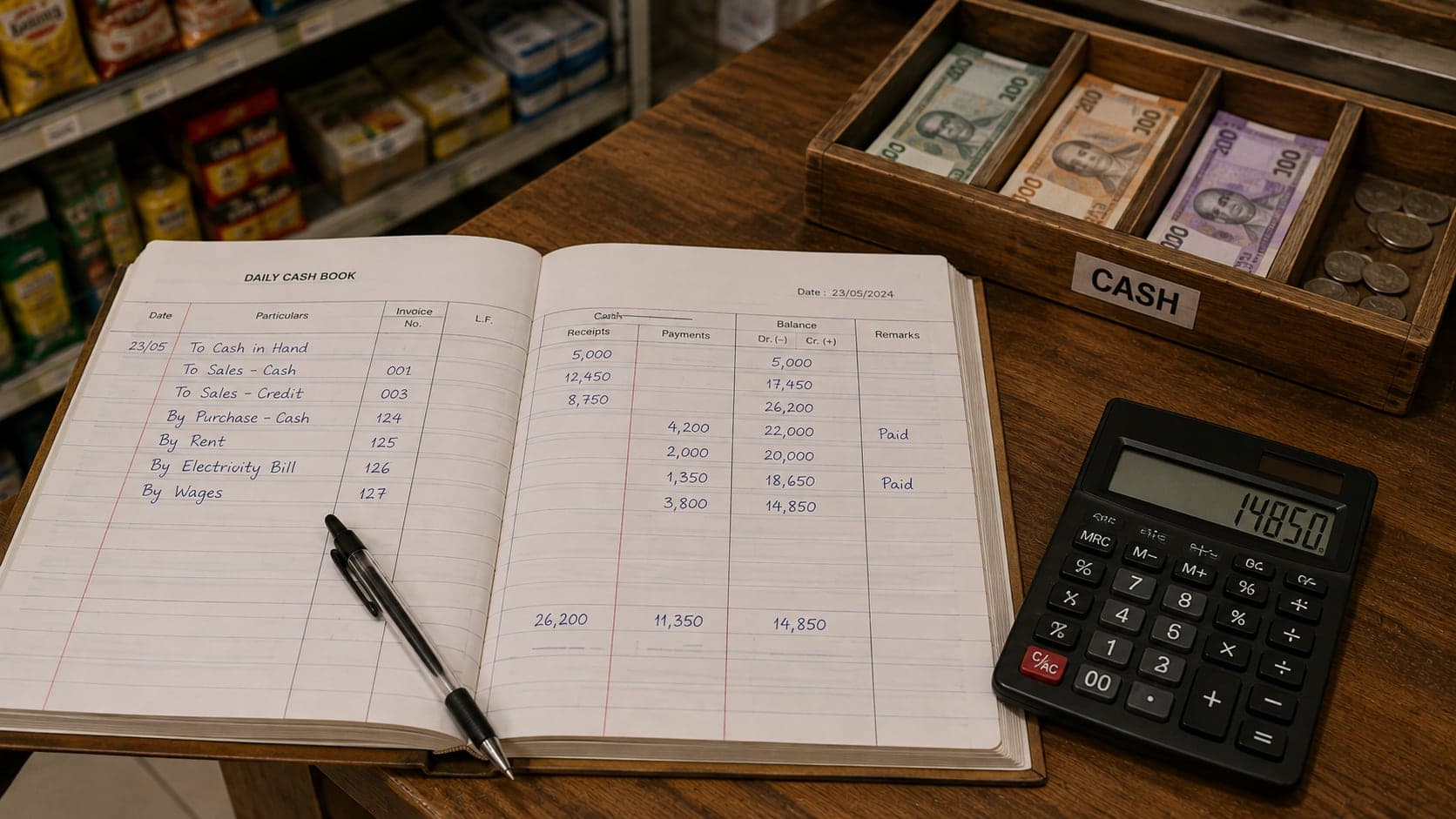
1. The cash book. Every unit of money that enters or leaves the till, with a word of explanation. Opening float, sales received, expenses paid, cash banked, owner drawings. At any moment: expected cash = opening + in − out. The daily close (below) checks the drawer against this number.
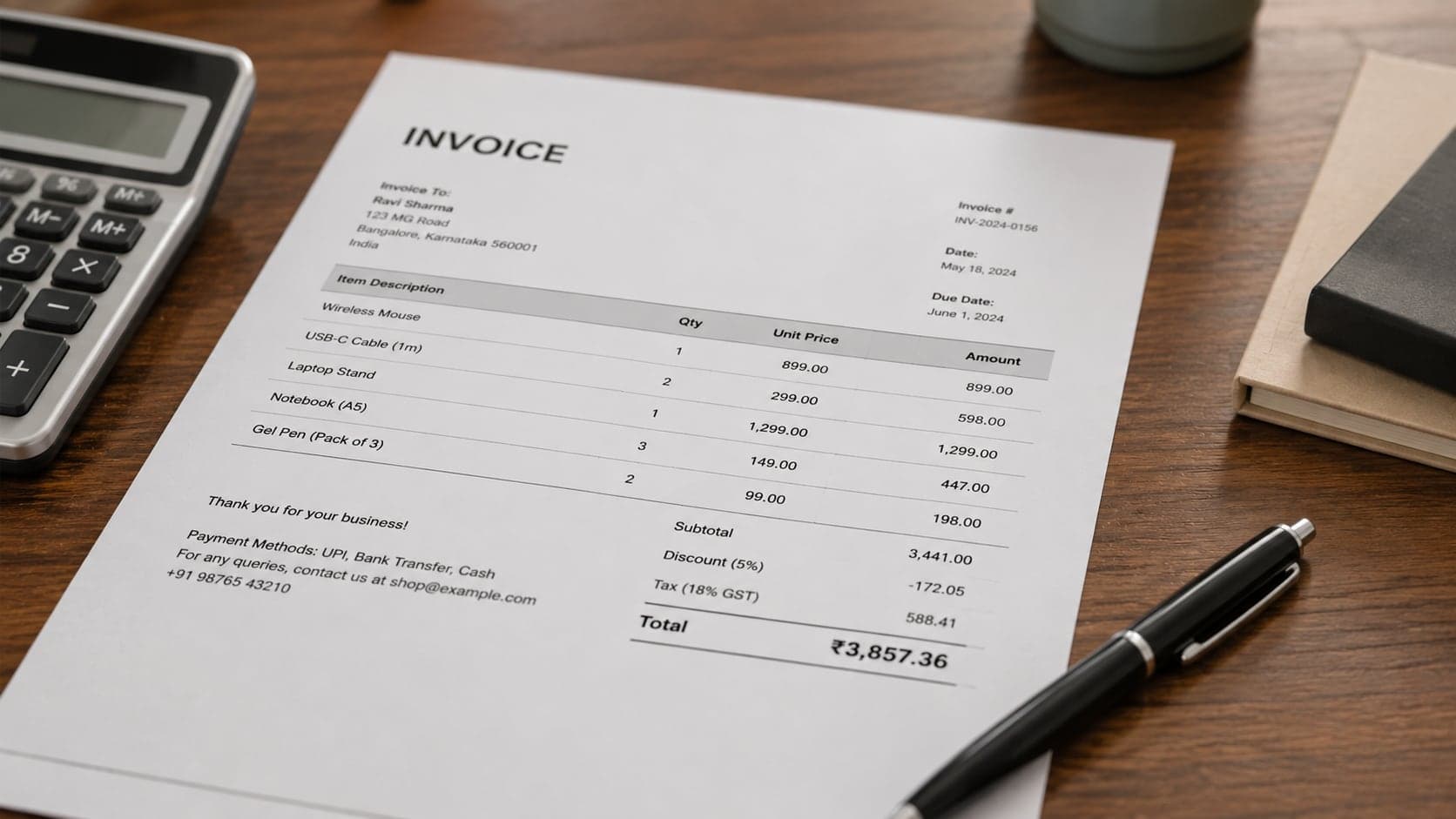
2. The sales record. Every sale, with items, amounts, and how it was paid — cash now or credit later. If a POS system runs your counter, this record builds itself; on paper it is the duplicate bill book plus a daily summary line.
3. The party ledgers. One page (or account) per person or business you trade with on credit — customers who owe you, suppliers you owe. This is the record shops in much of the world call the khata, and it deserves its own section.
Ledgers in plain words
A ledger is a running story of one relationship, told in numbers. Only three kinds of line ever appear in it: they took value (their debt to you grows), they gave value (their debt shrinks), and the balance after each line. Here is a customer ledger over one month:
Ledger: Rahim General Store (customer)
| Date | Entry | They took | They gave | Balance owed |
|---|---|---|---|---|
| 01 Aug | Opening balance | — | — | 4,200 |
| 05 Aug | Invoice INV-0521 (goods) | 6,300 | — | 10,500 |
| 12 Aug | Cash received (receipt R-0288) | — | 5,000 | 5,500 |
| 19 Aug | Invoice INV-0547 (goods) | 3,900 | — | 9,400 |
| 26 Aug | Returned damaged goods (CN-0071) | — | 700 | 8,700 |
Read it once and you know everything about this relationship: Rahim buys steadily, pays substantially but not fully, and the balance is drifting upward — 4,200 to 8,700 in a month. That drift is precisely what a pile of loose receipts can never show you, and it is the early-warning signal the credit policy below acts on.
Supplier ledgers are the same table with the roles reversed: their deliveries increase what you owe, your payments decrease it. Keep both directions with equal care. Shops naturally watch what customers owe them and stay vague about what they owe suppliers — then a sudden “please clear your account” call meets a drawer that was never warned.
If you hear accountants say debit and credit, they are naming the two columns above with Latin manners. The words carry centuries of convention; the concept is “took / gave / balance.” You now know the concept.
Customer credit that does not become charity
Credit is not a flaw in shopkeeping — in many neighbourhoods and in all wholesale trade, it is the business model. Unmanaged credit is the flaw. A working credit policy fits on an index card:
- A limit per customer, decided in daylight. Decide what each named customer may owe at most — based on their buying history and your tolerance — before the busy hour, not during it. New customers start small; limits grow with paid history, like trust does.
- Every credit sale documented and acknowledged. A named account, an invoice or signed slip, a due expectation. The five extra seconds are the entire legal and social difference between a debt and a story.
- Ageing watched monthly. Sort balances by how old they are: current, 30 days, 60, 90+. Money ages badly — industry experience and common sense agree that the older a balance, the less of it ever arrives. The 60-day column is where phone calls belong; the 90-day column is where new credit stops.
- Reminders on schedule, in writing where possible. A statement handed over monthly does the awkward work for you — it makes the balance a shared fact rather than an accusation.
- A stop rule you actually apply.“At the limit, or anything past 60 days: cash only until cleared.” Enforced kindly and universally, it offends nobody; enforced selectively, it offends everybody.
One more habit separates shops that collect from shops that hope: when a customer pays anything, write the receipt and say the new balance aloud. Both sides staying synchronised monthly costs nothing and prevents the year-end archaeology that ruins relationships.
The daily close: fifteen minutes that pay for themselves
The daily close is the ritual that makes all the records above mean something. Done every evening, it takes a quarter of an hour; skipped for a month, it becomes an investigation.
- Total today's sales from the sales record, split by payment: cash, bank/wallet, credit.
- Compute expected cash: opening float + cash sales + credit payments received in cash − expenses paid from the till − cash banked during the day.
- Count the drawer. Physically, coins included. Write the counted figure next to the expected one.
- Explain the difference — today.Small change rounding happens. A meaningful gap gets investigated while the day is still in everyone's memory: a bill not rung up? an expense unrecorded? a mistake in change? The answer is always cheaper tonight than on Friday.
- Post the credit.Today's credit sales and credit payments go into the party ledgers now, not “later.” Later is where ledgers die.
- Set tomorrow's float at a fixed amount, bank the excess, and note both in the cash book.
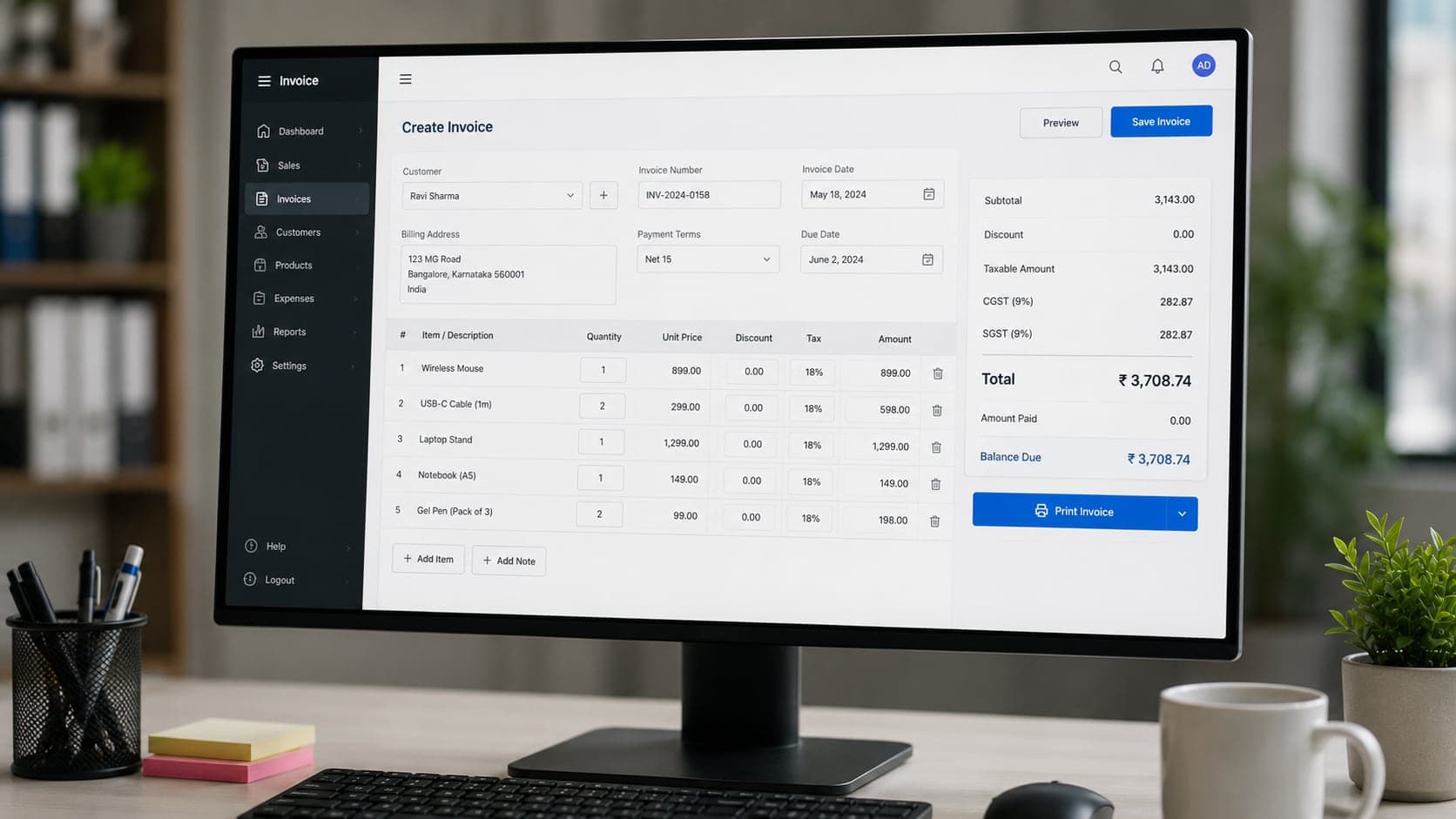
Software compresses most of these steps into a printed day-close summary you count the drawer against, which is exactly why the habit predates computers and survives them: the value is in the comparison, not the arithmetic.
Weekly and monthly rhythms
Weekly, in ten minutes:glance at the receivables ageing (who crossed 30 days this week?), check supplier dues against the coming week's cash, and look at the sales total against the same week last month — not for ceremony, but because trends caught at week two are corrections, and trends caught at month three are crises.
Monthly, in an hour: statements to every credit customer with a balance; a skim of the expense log sorted largest first (the surprises live at the top); a look at slow stock (money asleep on shelves — the inventory guide covers waking it); and the profit estimate below, written down in the same notebook every month so the year tells its own story.
Keep shop money and home money apart
In most small shops the till doubles as the family wallet — school fees at noon, groceries at eight, a loan to a cousin somewhere in between. No rule of accounting says the owner cannot use the shop's money; the shop is theirs. The damage comes from not writing it, because every unrecorded withdrawal corrupts three records at once: the cash book stops matching the drawer, the daily close finds gaps nobody can explain, and the monthly profit figure quietly absorbs the household budget until the shop looks like it earns nothing.
The fix costs one line: every amount taken for personal use is written in the cash book as a drawing, dated, with the owner's name. Do the same in reverse when personal money props up the shop — a capital in line. Two habits make this stick in practice:
- Pay yourself a fixed weekly amountinstead of grazing from the drawer. A regular, recorded drawing turns “whatever the till can spare” into a number you can plan a household around — and shows you what the shop actually pays its owner.
- Give family purchases a line too.Goods taken home from the shelf are stock leaving without a sale; write them at cost as a drawing. Otherwise they surface later as “shrinkage” and point suspicion at staff who did nothing.
Shops that keep this boundary discover something useful within a quarter: the business and the household each have their own truth, and both are easier to defend — to a spouse, to a partner, to a bank asking for statements.
The expense log: small money, big truth
Rent and salaries are hard to forget. What escapes is the small stream — courier charges, a replacement bulb, chai for the electrician, the rickshaw that delivered an urgent order. Each is trivial; together they commonly swallow several percent of sales, which for a five-percent-net shop can be half the profit. An expense log is the cash book's companion: date, amount, one-word category, half-a-word description.
Categories do the analytical work later, so pick a handful and stay loyal to them: rent, salaries, utilities, transport, supplies, repairs, fees, misc. The discipline rules are two. First, write the expense when the money leaves, not at night from memory — memory rounds down. Second, keep “misc” under ten percent of the log; when it grows past that, it is hiding a category you need to see, and usually the one growing fastest.
The monthly reward for this small labour: sort the log by category, largest first, and read the top three aloud. Owners are reliably surprised — transport that doubled since the new supplier, “repairs” that are really one machine dying slowly and expensively. The log converts those from vague unease into decisions with numbers attached.
Bank, wallets, and digital payments
Counters increasingly take money the drawer never sees — bank transfers, cards, mobile wallets. Each channel is a second till and needs the same honesty as the first: record the method on every sale, and reconcile each channel against its own statement on its own rhythm. Cash reconciles nightly against the drawer; the wallet and bank reconcile weekly against their apps, line by line, ticking each incoming payment against a recorded sale or a ledger receipt.
Two channel-specific traps are worth naming. Digital payments can arrive late or fail silently— a customer's “sent” screen is not money; only the confirmation on your side is, and the polite moment to check is before the goods leave. And fees hide inside settlements: a thousand received may land as nine-hundred-something. Record the fee as an expense rather than letting sales quietly shrink, or month-end totals will disagree with the sales record for reasons nobody remembers.
Profit math without an accountant
Two layers of profit matter to a shop, and confusing them is how busy shops go broke:
Gross profit is sales minus the cost of the goods sold. Sold 300,000 of goods that cost you 240,000? Gross profit 60,000 — a 20% margin. Every expense the shop has must be paid out of that 60,000, never out of the 300,000, which is only a number passing through.
Net profit is what remains after those expenses — rent, salaries, electricity, transport, fees, the tea. If they total 45,000, the shop truly earned 15,000: five percent of sales. That five percent is the figure that decides whether the shop is a livelihood or an expensive hobby, and it is knowable only if expenses were written down as they happened.
Worth engraving somewhere: margin and markup are different numbers.Buy at 80, sell at 100 — the markup is 25% (on cost), the margin is 20% (on price). Discounts eat margin: a “small” 10% discount on that item surrenders half its profit. Shops that let counter staff give unrecorded discounts are usually donating more than they suspect — one more thing the daily close makes visible.
The one-page monthly summary
Everything above converges into a single page an owner can write in twenty minutes on the first of each month — a small profit and loss statement in plain clothes. It reads like this for a neighbourhood shop:
AUGUST — ONE-PAGE SUMMARY
Sales (from sales record) .................. 412,000
of which on credit ....................... 96,000
Cost of goods sold ......................... 329,600
Gross profit (20.0%) ........................ 82,400
Expenses (from expense log) ................. 61,300
rent 25,000 · salaries 22,000 · utilities 6,100
transport 4,700 · other 3,500
Net profit (5.1%) ........................... 21,100
Customers owe us (receivables) ............. 118,400 ▲ from 104,000
We owe suppliers (payables) ................. 87,200 ▼ from 93,500
Owner drawings this month ................... 18,000
The last block is the one owners skip and accountants read first. Profit of 21,100 looks healthy — but receivables grew by 14,400, meaning two-thirds of the month's profit is currently parked in customers' pockets, not the drawer. That is not necessarily bad; it is necessarily worth knowing, because a profitable shop can still fail to pay its supplier on Thursday. Write this page every month, keep them in one folder, and twelve pages later you own something rare among small shops: a year of your business, in numbers, on paper you trust.
Paper, spreadsheets, or software?
Everything in this guide works in a ruled register, and for a single-person, low-credit shop, paper plus discipline is a respectable system. Its cost is arithmetic time and a single copy that fire, water, or loss can erase — photograph the pages monthly at minimum.
Spreadsheets add searching and sums, and suit a patient owner with a laptop and modest volume. Their weakness is silent: one deleted row, one broken formula, and history quietly changes with nobody the wiser.
Shop software earns its keep at volume, at credit, and at staff: sales post themselves to ledgers, balances update in real time, closes print themselves, and every entry carries a name and a timestamp that cannot be casually rewritten. If you evaluate software for this, judge the ledger screens with the same care as the sales screen — the buyer's guide includes the specific questions to ask.
A specimen day, with every record touched
To make the system concrete, here is an ordinary Tuesday at a small electrical-goods shop, seen through its records. Morning: the owner counts the float — 5,000 — and writes it as the cash book's opening line. Mid-morning: a contractor takes cable and switches worth 9,200 on account; the sale goes in the sales record marked credit, and 9,200 lands in the contractor's ledger under “took.” Noon: the wholesaler's delivery arrives with an invoice for 34,000 on fifteen-day terms — nothing moves in cash, but the supplier ledger grows by 34,000 and the stock record grows by the goods. Afternoon: a walk-in pays 2,600 cash for a fan (sales record, cash), the owner sends 300 with the boy for packing tape (expense log: supplies), and old Mr. Saleem clears 5,000 of his balance (receipt written, his ledger shrinks, cash book grows). Evening close: expected cash = 5,000 + 2,600 + 5,000 − 300 = 12,300; the drawer counts 12,250; the fifty-rupee gap turns out to be change given for the tape. Five records touched, maybe four minutes of writing across the whole day — and the shop's entire Tuesday can be reconstructed, defended, and learned from, forever.
That is the whole philosophy of shop accounting in one day: no single heroic effort, just small honest lines written at the moment things happen. The routines — daily close, weekly ageing, monthly summary — are simply ways of reading back what the day already wrote.
When to involve a professional
The records above are management accounting — they exist so the owner knows the truth daily. Tax filings, legal structures, audited statements, and loan paperwork are a different craft. The good news: an accountant handed clean cash books, sales records, and ledgers charges less and delivers more, because the expensive part of their work is usually reconstructing what a shoebox of receipts failed to say. Keep the three records well and professional help becomes an annual formality instead of a rescue operation.
FAQ
Frequently Asked Questions
Quick answers to common questions about this topic.
A relative wants credit beyond their limit. What now?
The limit is the answer precisely so you do not have to be. A policy applied to everyone — "that is where every account pauses until a payment" — protects the relationship by removing the personal judgement from the refusal. Shops without limits do not avoid this conversation; they postpone it until the amount makes it unwinnable.
How do I start ledgers when credit already exists informally?
Pick a cutoff date. Before it, agree each balance with each customer — show your notes, hear theirs, settle on a number, and write it as the opening balance, acknowledged if possible. Some negotiations will sting once. The alternative is that every future statement inherits the old fog.
Should the owner take money from the till freely?
Take what you like — it is your shop — but write it as a drawing, every time. Unrecorded owner drawings are the single most common reason honest tills "come up short" and honest staff feel silently accused. The record protects them and tells you what the shop actually pays you.
Do I need "real" double-entry bookkeeping?
Not to run the shop. The three records here are single-entry with discipline, and they answer the daily questions — cash, credit, profit — that keep a small business alive. What double-entry adds is systematic error-catching and the formal statements larger businesses, lenders, and some tax regimes require. The comfort is that clean single-entry records convert to formal books easily; an accountant can build double-entry from your cash book and ledgers in hours. Vague records convert to nothing.
How long should I keep old records?
Legal minimums for commercial records commonly run five to seven years — confirm locally. In practice, keep ledgers effectively forever: they are small, and old balances, warranty questions, and "what did we pay for this in 2023?" all age better than memory. Paper books go in a labelled box by year; digital records go wherever your backup actually is, tested once a year by opening a file.
Is a shortage in the drawer always theft?
Rarely. Most shortages are change errors, unrecorded expenses, or a sale that never got rung up. That is why the close happens daily: one day's memory can explain a gap, a month's cannot. Persistent one-direction gaps on particular shifts are a different pattern — and by then your records, not your suspicions, will be doing the talking.