What is SaaS development — and why do businesses need it?
Cloud software products with tenancy, billing, roles, and growth paths designed by Taylance Tech — so you ship a real product, not a demo that collapses under the second customer.
SaaS development means building software delivered as a service over the internet: customers sign up, access a shared or logically isolated product through the browser or API, and pay on a subscription or usage model. The product must handle many organizations on one platform while keeping each customer’s data, settings, and permissions correctly separated.
Businesses need SaaS development when their value is software that many customers will use continuously — not a one-off website or a private tool for a single company. Founders need it to validate a product with paying users. Established firms need it when an internal tool becomes a commercial offering, or when a spreadsheet workflow has outgrown email attachments and shared drives.
Buyers often underestimate what “SaaS” adds beyond a login screen: tenant isolation, plan entitlements, billing webhooks, invitation flows, admin tooling, audit trails, and operational monitoring. Skipping those pieces creates a prototype that cannot take money safely or onboard a second company without panic.
Taylance Tech builds SaaS products as a professional service: product scoping, multi-tenant architecture, authentication and roles, subscription or usage billing, APIs, admin surfaces, launch hardening, and iteration from real usage. We will tell you when an MVP is enough — and when enterprise demands require earlier investment in security and tenancy design.
Good SaaS work also includes the unglamorous pieces that keep revenue and trust intact: webhook reconciliation, invitation edge cases, plan downgrade behavior, and support tools that do not require production database access. Those details separate a product you can operate from a prototype you fear to sell.
Problems
Problems that push teams toward SaaS development
These product and operations pains appear before buyers search for a SaaS engineering partner.
A useful prototype that cannot onboard a second company
The first tenant works because data was hard-coded. Real customers need isolation, roles, and settings that do not collide.
Billing bolted on after the product already shipped
Trials, upgrades, failed payments, and plan limits become fragile patches instead of designed entitlement rules.
Every new customer needs a custom deployment
One codebase per client destroys margin. Shared infrastructure with tenant boundaries is the sustainable path.
Feature requests without a product spine
Roadmaps turn into a pile of one-off screens because nobody defined the core loop, roles, or what “done” means for v1.
Security and access questions from larger buyers
SSO, audit logs, and clearer permission models appear late — right when a deal depends on answering them.
No visibility into usage, churn signals, or failures
Without product analytics and operational logs, teams guess why customers leave or which features matter.
Services
SaaS development services we provide
Engagements aimed at shipping a cloud product customers can pay for and trust.
Multi-tenant product architecture
Shared platforms with clear tenant boundaries, data isolation strategies, and room to grow without rebuilding from zero.
Subscription and usage billing
Plans, trials, upgrades, metering, webhooks, and entitlement checks wired so access matches what customers paid for.
Authentication, roles, and team access
Sign-up, invitations, role-based permissions, and optional SSO paths designed for how your buyers actually work.
Customer and operator admin surfaces
Dashboards for your team and for tenant admins: users, billing status, configuration, and operational controls.
API-first product design
Documented APIs and webhooks so customers and partners can integrate, and so your own clients stay consistent.
MVP to scalable platform path
A first release that proves the core loop, then architecture choices that do not trap you when volume arrives.
Guides
Related reading
Vendor-neutral guides on related topics — written to be useful on their own.

Cloud POS Systems
How browser-based point-of-sale works, what happens when the internet drops, multi-location access, and an honest comparison with installed software.
Multi-Store POS
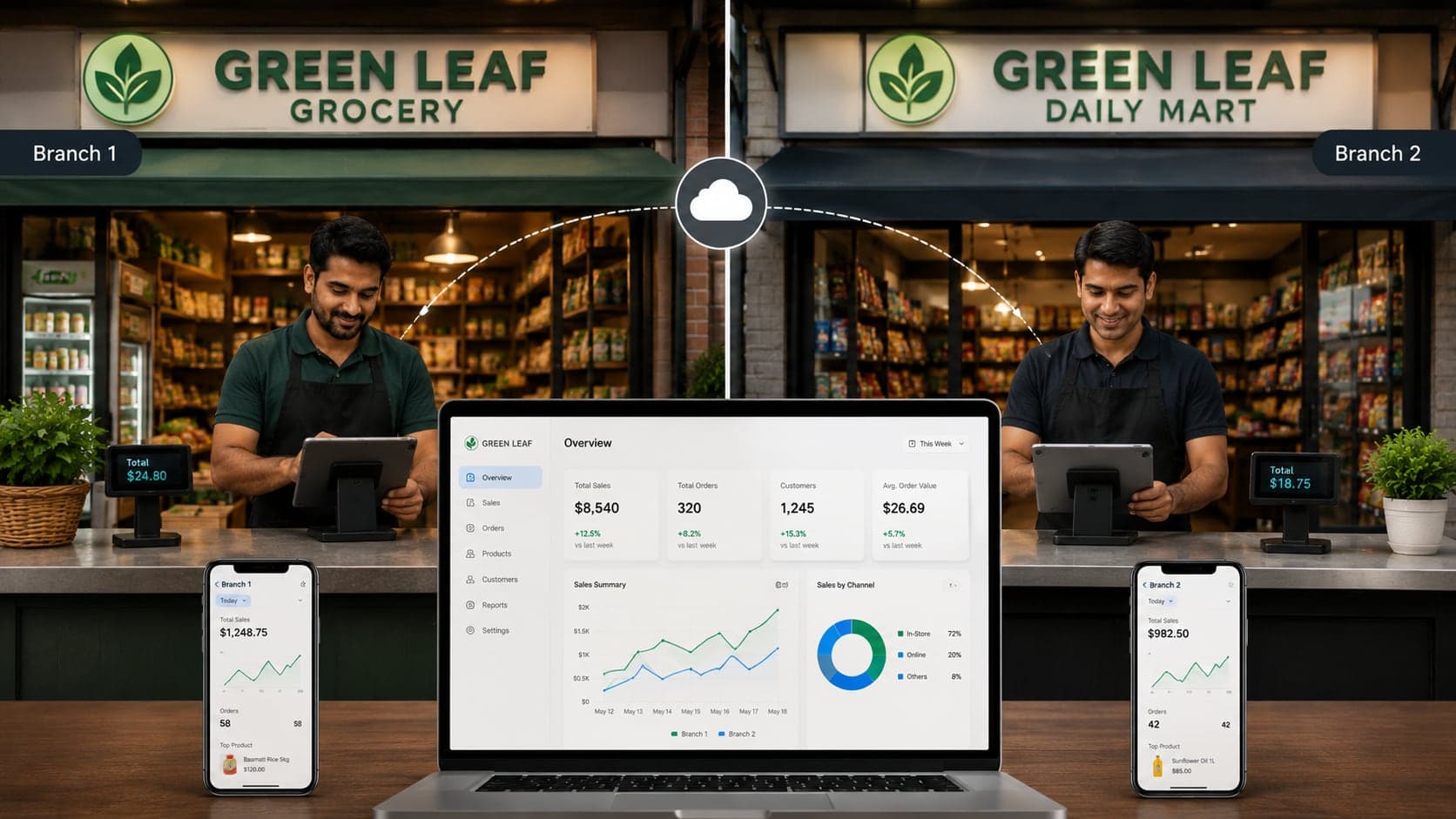
One product catalog, stock per branch, role-based access, and the architecture choices that keep a second location from becoming a second problem.
Browse the full collection on all guides, or read engineering articles on our blog.
Definition
What professional SaaS development includes
A practical definition for founders and product owners.
SaaS development designs and builds a software product that many customers access over the network, typically with accounts, organizations, recurring billing, and ongoing updates controlled by the vendor. The engineering work covers application features, tenancy, identity, payments, APIs, admin tooling, and the operational habits that keep the product reliable.
Professional delivery includes product scoping, architecture for multi-customer use, secure authentication, entitlement design tied to plans, data isolation, launch readiness, and a path to iterate after real usage. A clickable prototype without billing or tenant boundaries is not a complete SaaS outcome.
Taylance Tech focuses on products your team can operate and extend. The goal is a codebase and architecture that survive the second, twentieth, and two-hundredth customer — not a demo that only impresses investors.
- Core product loop defined before feature sprawl
- Tenant and role model written explicitly
- Billing events mapped to access rules
- Admin and support surfaces planned for day-two operations
Why businesses need it
Why businesses need SaaS development
When software must serve many customers as a product.
Businesses need SaaS development when revenue depends on selling software access continuously. Spreadsheets, one-off scripts, and single-company deployments do not produce the same margins or update velocity as a shared product.
They need it when an internal tool has demand outside the company. Turning that tool into SaaS requires tenancy, packaging, and support paths that internal-only software never needed.
They need it when custom builds for each client stop scaling. Multi-tenant platforms keep one roadmap while still allowing configuration that larger customers expect.
They do not need a full platform on day one. A focused MVP with clean boundaries often beats a feature encyclopedia that never ships. We help you choose the smallest product that can take money honestly.
Multi-tenancy
Multi-tenant architecture choices that matter
Isolation strategies matched to risk and stage.
Multi-tenancy means many customers share infrastructure while remaining logically separated. Common patterns include shared databases with tenant keys and row-level security, schema-per-tenant designs, or rarer dedicated deployments for high-isolation deals.
Early products often succeed with a shared database and strong tenant filters enforced in the data layer — not only in UI code. UI-only filtering is how accidental data leaks happen.
We document the tenancy model: what an organization owns, how users belong to orgs, and how queries and APIs always carry tenant context. That documentation becomes the spine for features and audits.
Changing tenancy models later is expensive. Choosing a pragmatic isolation approach early — with room to offer higher isolation later — saves painful migrations when enterprise buyers arrive.
Billing
Subscription billing, trials, and entitlements
Money and access treated as one system.
SaaS billing is more than a checkout button. Plans define limits, trials expire, upgrades expand access, downgrades restrict it, and failed payments need dunning and grace policies you can explain to customers.
We wire payment providers through webhooks and reconcile events so the product’s entitlement state matches reality. Silent webhook failures create angry users who paid but cannot access features.
Usage-based and hybrid models need metering that is accurate enough to invoice and clear enough to dispute. Guesswork meters destroy trust.
Entitlement checks belong in the application and API layers consistently. Hiding a button without enforcing the limit server-side is not billing design — it is theater.
Identity
Authentication, invitations, and team roles
How people join and what they are allowed to do.
Identity work covers sign-up, login, password resets, invitations, and session security. For B2B products, invitation flows and org membership are as important as the login form itself.
Role-based access control should mirror real jobs: owner, admin, member, billing contact, read-only auditor. Too few roles force privilege sharing; too many confuse onboarding.
SSO and SAML often appear when larger customers buy. We design so those paths can be added without rewriting tenancy — even if v1 uses email-based auth only.
Audit-friendly logs of sensitive actions (invite, role change, billing change) help support and security reviews. They are cheaper to add early than to invent under pressure.
MVP
SaaS MVP development without painting yourself into a corner
Speed with a spine.
An MVP should prove the core loop: a user can complete the main job that justifies payment. Everything else is a candidate for later — including polished settings screens nobody opens in week one.
We still insist on correct tenant boundaries, basic roles, and a billing path that matches the monetization story. Shipping “free forever” while planning paid plans without entitlement hooks creates debt.
Analytics on activation and retention belong in the MVP when you need evidence for the next build cycle. Vanity dashboards can wait; funnel clarity cannot.
We write an explicit out-of-scope list. That list protects timelines more than optimistic feature matrices.
Onboarding
Product onboarding for the first session that matters
Empty states and setup paths that reduce early churn.
SaaS products die in the first session when users land in a blank UI with no next step. Onboarding should guide setup: create a workspace, invite a teammate, import a sample, complete one meaningful action.
We design empty states and checklists as product surfaces, not afterthought copy. Support tickets often start where onboarding ends abruptly.
Different roles need different first paths. An owner configuring billing is not the same journey as a member completing daily work.
Measure time-to-value. If that number is long, feature marketing will not save retention.
Admin tooling
Operator admin and customer admin dashboards
Day-two operations without raw database access.
Your team needs an operator console: find a tenant, check plan status, reset access carefully, inspect recent errors, and support customers without improvising SQL under stress.
Tenant admins need their own surfaces: manage users, view invoices or plan status, configure workspace settings, and export data when promised.
Admin power without safeguards creates risk. Destructive actions need confirmation, logging, and role gates.
Building these tools after launch is common — and expensive. We include a minimal but real admin path in early releases so support is not a liability.
APIs
API-first design for SaaS products
Integrations as a product promise, not a side project.
API-first means the same business rules power the UI and external clients. Customers who automate, partners who embed, and your own mobile or future clients all benefit.
We design authentication for APIs (keys, OAuth, scoped tokens), rate limits, and clear error shapes. A pretty UI with an inconsistent API frustrates technical buyers.
Webhooks notify external systems of events: new users, plan changes, important domain events. Reliable delivery and retry semantics matter as much as the payload schema.
Documentation is part of the product. If only your team understands the API, it is not yet an ecosystem feature.
Data isolation
Data isolation, backups, and export expectations
Trust foundations buyers quietly evaluate.
Customers assume their data cannot be seen by other tenants. Tests should include hostile cases: wrong IDs, swapped tokens, and admin mistakes.
Backups and restore drills are operational requirements, not optional DevOps hobbies. A SaaS without a restore story is a reputation risk.
Data export and deletion requests appear as you grow. Designing exportable ownership early reduces panic when a contract or regulation requires it.
We keep isolation rules centralized. Scattered “remember to filter by org” comments in application code are not a security strategy.
Enterprise readiness
Growing toward enterprise buyer requirements
What larger deals usually demand next.
Enterprise buyers ask about SSO, audit logs, permission granularity, uptime expectations, and data residency. Not every MVP needs all of these on day one — but architecture should not forbid them.
We help you sequence enterprise features against real pipeline demand. Building SAML before you have ten paying teams can be wasteful; refusing to plan for it can lose a deal later.
Security questionnaires are easier when you have written tenancy, auth, and logging stories. Improvised answers slow sales.
Custom SLAs and dedicated environments are commercial decisions with engineering cost. We surface those tradeoffs clearly instead of promising everything in a proposal.
Observability
Monitoring, product analytics, and operational health
Seeing problems before customers write angry emails.
Application monitoring catches errors, latency, and failed jobs. Product analytics catch activation, feature usage, and churn signals. SaaS needs both.
Billing and webhook pipelines deserve dedicated alerts. Silent payment failures are a special category of outage: the product looks fine while revenue breaks.
Tenant-aware logging helps support find issues without exposing other customers’ data in shared log streams.
We define a small set of health metrics at launch and expand as volume grows. Dashboard theater without action owners helps nobody.
Background jobs
Jobs, queues, and asynchronous work in SaaS
Work that cannot finish inside a single request.
Imports, report generation, email digests, and metering rollups belong in background jobs. Trying to do everything in HTTP requests creates timeouts and partial failures.
Jobs must be tenant-aware and idempotent where possible. Retrying a charge or invite without care creates duplicates customers notice immediately.
Dead-letter handling and visibility for failed jobs belong in operator tooling. Invisible queues become mysterious product bugs.
We design job boundaries during architecture, not after the first production timeout.
Configuration
Tenant configuration without forking the codebase
Flexibility that preserves one product roadmap.
Customers want branding, feature flags, workflow toggles, and integration settings. The trap is implementing each request as a unique fork.
We prefer configuration and feature flags tied to plans or tenant settings. That keeps one codebase while allowing controlled differences.
True custom development for a single tenant should be rare, priced honestly, and isolated so it does not poison the shared product.
Documenting what is configurable versus what requires engineering protects sales from promising impossible same-day customizations.
Migrations
Migrating from custom builds or legacy tools into SaaS
Moving customers without losing their trust — or their data.
Teams often arrive with several client-specific deployments or a legacy monolith. Consolidation into multi-tenant SaaS needs a migration plan: data mapping, cutover windows, and communication.
We inventory what must move, what can be archived, and what will be redesigned. Copying every quirk into the new product recreates the old mess.
Pilot tenants reduce risk. Full-fleet cutovers without a rehearsal are how weekends disappear.
Redirects, API compatibility shims, and dual-run periods are sometimes necessary. We treat migration as a product project, not a quiet database dump.
Security habits
Security habits in SaaS delivery
Practical controls matched to stage — without theater.
Baseline habits include secure session handling, least-privilege roles, secrets management, dependency updates, and protection against common web vulnerabilities.
Tenant isolation tests are security tests. Treat them with the same seriousness as login brute-force protections.
We do not claim compliance certifications you do not have. We do implement technical practices that make future audits less painful and sales answers more honest.
Incident response basics — who is paged, how tenants are notified, how access is rotated — should exist before you need them.
Performance
Performance and scaling for multi-customer load
Growth that does not require a surprise rewrite.
SaaS performance problems often appear as noisy-neighbor issues: one tenant’s heavy export slows everyone. Quotas, pagination, and background processing reduce that risk.
Database indexes, caching, and query patterns should respect tenant filters. Global scans that ignore tenancy hurt both speed and isolation.
We plan for horizontal growth where it matters — app servers, queues — and be honest about database scaling costs. Premature microservices rarely help early-stage products.
Load testing against realistic multi-tenant scenarios beats testing with a single demo account.
Engagement models
How SaaS development engagements are structured
Commercial clarity for product builds.
Most engagements start with discovery that produces a scoped MVP or phase-one backlog, tenancy decisions, and a billing approach. Building without that step invites endless rework.
Fixed-scope phases work when the core loop is clear. Retainers or ongoing product partnerships fit teams iterating after launch with a steady backlog.
You work directly with practitioners who can discuss product tradeoffs and technical constraints — the standard at Taylance Tech.
Ownership of repositories, domains, billing accounts, and cloud projects should sit with you. We build inside your accounts whenever practical so handoff is real.
Mistakes
SaaS project mistakes we help clients avoid
Patterns that waste runway and trust.
Building dozens of features before a paying customer completes the core loop.
Storing tenant data without enforced isolation in the data layer.
Treating billing as a week-one afterthought.
Skipping operator admin tools and living in the database.
Promising enterprise SSO in a proposal with no architecture path.
Launching without webhook monitoring for payment events.
Letting every customer become a custom fork of the product.
Myths
Myths about SaaS development services
Claims that distort buying decisions.
Myth: SaaS is just a website with a login. Reality: tenancy, billing, and operations are the product.
Myth: You must build every enterprise feature before launch. Reality: sequence them against real demand while keeping the spine clean.
Myth: Multi-tenant always means weak security. Reality: well-designed shared platforms can isolate data rigorously.
Myth: An MVP cannot include billing. Reality: if you plan to charge, entitlements belong in the first honest release.
Myth: APIs can wait forever. Reality: API inconsistency becomes expensive once integrations exist.
Choosing a partner
How to choose a SaaS development partner
Questions that reveal product maturity.
Ask how they design tenancy and where isolation is enforced. Ask how billing events update access. Ask what admin tooling ships with v1.
Ask who owns cloud accounts, code, and payment provider configuration. Vague ownership answers are a warning sign.
Ask how they handle scope when sales wants “just one custom feature” for a big prospect. Discipline here protects your roadmap.
Taylance Tech expects these questions. We would rather narrow an MVP than oversell a platform fantasy.
Poor fit
When SaaS development is a poor fit
Honest stop signs before budget is spent.
If you need a marketing website or a brochure site, web development is the better service — not a multi-tenant platform engagement.
If only one organization will ever use the software, a single-tenant application may be simpler and cheaper than SaaS tenancy overhead.
If the product idea has no defined core loop or buyer, discovery and positioning work should come before a large build.
If stakeholders demand a fully custom product for every customer while calling it SaaS, the business model and architecture are in conflict.
If nobody will own product decisions after launch, the codebase will stall. SaaS requires an ongoing owner, not only a launch date.
Professional limits
Professional expectations for SaaS delivery
What Taylance Tech commits to — and what we will not claim.
Expect careful scoping of the core loop, tenancy-aware architecture, billing and entitlement design, authentication and roles, practical admin tooling, and launch habits that respect operations.
Do not expect guaranteed user growth, guaranteed revenue, or claims that a product will “scale infinitely” without cost. We design for measured growth and honest tradeoffs.
Do not expect unlimited feature invention inside a fixed price without prioritization. Discovery and phased delivery exist to bound uncertainty.
Within those limits, SaaS development should give you a product customers can pay for, trust, and use repeatedly. That is the service we provide.
First release
A grounded first-release plan for SaaS
What a serious v1 usually contains.
A grounded first release includes the core job, tenant and role basics, a monetization path that matches your story, onboarding that reaches first value, and enough admin capability to support customers without panic.
Documentation covers how tenancy works, how plans map to features, and known limitations. Future engineers and future you will need that clarity.
After launch, you review activation, payment success, support load, and whether the core loop holds. Expansion follows evidence.
Only after that foundation do we invest heavily in marketplace integrations, advanced enterprise controls, and secondary products that depend on a stable spine.
- Core loop demoable end to end
- Tenant isolation tested with hostile cases
- Billing webhooks monitored
- Owner named for post-launch product decisions
Process
How our SaaS development process works
A delivery sequence that keeps product risk visible early.
Product and domain discovery
We clarify who the buyer is, the core job the product must do, tenancy model assumptions, and what must ship in the first paid release.
Architecture and entitlement design
We define tenant isolation, roles, plan limits, billing events, and integration boundaries before features harden the wrong shape.
Iterative product build
We implement the core loop in short cycles with demos you can use. Billing and auth are treated as product features, not leftovers.
Hardening and launch readiness
We test tenancy boundaries, payment webhooks, invitation flows, and failure modes. Monitoring and backup basics are part of launch.
Post-launch iteration
We improve from usage data, support tickets, and sales feedback — expanding plans and enterprise needs without rewriting the spine.
Compare
Thoughtful SaaS builds vs common shortcuts
What changes when tenancy, billing, and operations are designed together.
| Criterion | With Taylance Tech | Common shortcut |
|---|---|---|
| Customer isolation | Tenant boundaries designed into data and APIs | Shared tables with hope and manual filters |
| Billing and access | Entitlements match plans and webhook events | Manual plan toggles and forgotten downgrades |
| Onboarding | Invites, roles, and empty states for real teams | A login and a blank dashboard |
| Growth path | MVP that can add SSO and metering later | A rewrite when the first enterprise deal appears |
| Operations | Admin tools and logs for support and incident response | Database edits as the only admin console |
| When SaaS is overkill | We say so if a single-tenant app is enough | Every internal tool sold as a platform |
Stack
Technologies we work with
Application, data, billing, and identity tools chosen to fit the product — not collected for a proposal slide.
Next.js
Application
React
Application
TypeScript
Language
Node.js
Backend
PostgreSQL
Database
Row-Level Security
Tenancy
Stripe
Billing
Paddle
Billing
Redis
Cache & queues
REST & webhooks
API
OAuth / SSO
Identity
Docker & cloud hosts
Infrastructure
Fit
Who this SaaS development service fits
Teams building a product for many customers — not a single-company internal utility dressed up as SaaS.
- Founders validating a B2B or B2C software product with real billing
- Companies turning an internal tool into a commercial offering
- Teams replacing per-client custom builds with one multi-tenant platform
- Product leaders who need tenancy, roles, and plans designed together
- Startups preparing for larger buyers who ask about SSO and audit trails
- Operators who need admin tooling and APIs, not only a customer UI
Checklist
SaaS development readiness checklist
Confirm these items before a major build so the first release can take real customers.
- Buyer and primary user roles named
- Core loop described in concrete steps
- Tenant model chosen and written down
- Plan or pricing story mapped to entitlements
- Must-have v1 features listed with an out-of-scope list
- Invitation and onboarding path sketched
- Admin and support needs for week one identified
- Payment provider and account ownership decided
- Data export or deletion expectations noted
- Analytics events for activation agreed
- Security baseline expectations written
- Hosting and repository ownership confirmed
- Success metrics for the first release dated
- Product owner available for ongoing decisions
- Known enterprise asks parked in a later phase (if any)
Related
Related services
Other ways we can help when your project spans more than one discipline.
FAQ
SaaS development questions
Straight answers about multi-tenancy, billing, MVPs, admin tooling, and ownership.
How do you handle multi-tenant architecture and data security?
We design tenant boundaries into the data and API layers — often with PostgreSQL row-level security and consistent org context on every request — so one customer cannot read another customer’s records. Authentication and roles sit on top of that isolation model.
Can you integrate Stripe or other subscription billing providers?
Yes. We implement plans, trials, upgrades, usage metering where needed, checkout flows, and webhook handling so entitlements stay aligned with payment events. Provider choice follows your market, tax, and operational needs.
What is your approach to building a SaaS MVP?
We prioritize the core loop that proves value, plus the tenancy, auth, and billing spine required to charge honestly. Analytics on activation help decide what to build next from real behavior rather than assumption lists.
Do you build admin dashboards for our team and for customers?
Yes. Operator tools help your team support tenants safely; customer admin surfaces let workspace owners manage users, settings, and plan-related controls without waiting on engineering for routine tasks.
Can the product expose an API for integrations?
Yes. We commonly design API-first surfaces with authentication, clear errors, and webhooks so customers and partners can connect their own systems as the product grows.
Who owns the code, cloud accounts, and billing configuration?
We recommend that you own repositories, cloud projects, domains, and payment provider accounts, with appropriate access for our team during the engagement. Ownership details are confirmed in writing.
How long does a typical SaaS MVP take?
Timelines depend on scope, integrations, and how clear the core loop is. After discovery we provide a phased plan with milestones. Fixed dates without a scoped backlog are guesses we will not pretend are promises.
How do we start?
Contact Taylance Tech with the problem your product solves, who pays, and any constraints around tenancy, billing, or launch date. We respond with fit assessment and a proposed discovery or build path.
Ready to discuss your SaaS product?
Tell us who the buyer is, the core job the product must do, and any constraints around tenancy, billing, or launch. We will give an honest read on fit, MVP shape, and next steps.