Inventory Management for Shops: Stock, Barcodes, and Purchase Orders

Inventory is usually the largest pile of money in a shop, and the least watched. This guide is organised as three working parts — keeping stock records that match the shelf, putting barcodes to work, and buying from suppliers with proper purchase orders — plus a from-zero setup checklist at the end. It assumes no prior systems knowledge, only a shop with goods in it.
One idea holds the whole subject together, so it is worth stating before the parts begin: stock on the shelf is cash in another costume. Every carton in the storeroom is money that cannot currently pay rent, salaries, or suppliers. Managed well, it changes back into more cash than it cost. Managed vaguely, it leaks — through theft nobody noticed, expiry nobody caught, over-buying nobody questioned, and stock-outs that sent loyal customers to the shop across the road. Inventory management is simply the habit of knowing what the pile is doing.
Part 1: Stock records that match the shelf
Start with an honest product list
Every inventory system, from a notebook to enterprise software, rests on a product list. The rules that make one usable:
- One entry per distinct sellable thing.If customers can ask for it specifically, it is its own item. A 750 ml bottle and a 1.5 L bottle of the same drink are two items with two prices and two stock counts — merging them makes both numbers meaningless.
- Names a new employee could find. “Sunlight soap 150g” beats “S.L. lrg”. You are not writing for yourself today; you are writing for the busiest hour of the shop six months from now.
- A fixed unit per item. Decide whether rice is tracked in kilograms or bags, and never mix. If you buy in bags and sell in kilos, the conversion (1 bag = 25 kg) must be written into the item, not remembered.
- Cost and selling price stored together. Stock records that ignore cost cannot tell you what the shelf is worth or what you earned — they become counting exercises instead of management tools.
Track movements, not moments
The amateur method records how much stock exists — occasionally, heroically, after closing. The working method records movements: every way quantity changes, at the moment it changes. There are only five:
- In from a supplier (a purchase arrives).
- Out to a customer (a sale — recorded automatically if sales go through a POS).
- Back from a customer (a return to the shelf, if resellable).
- Out as an adjustment (damage, expiry, theft, breakage — written down honestly).
- Across locations (a transfer between storeroom and shelf, or branch and branch).
If all five kinds of movement are captured, the current quantity is just arithmetic, and the record stays honest without anyone counting the shelf daily. Miss even one kind — most shops miss adjustments — and the record drifts until nobody trusts it, at which point people stop maintaining it, and the whole system dies. The discipline is not complicated; it is only constant.
A word on negative stock, because every shop meets it: the system says minus three, the shelf plainly has some. Negative stock is never true — it is a message. Either a delivery was sold before being entered (the commonest cause), a unit conversion is wrong somewhere, or sales are being recorded against the wrong item. Treat each negative as a small alarm worth two minutes the day it appears: find which movement was missed, enter it properly, and the number heals. Shops that ignore negatives — or worse, bulk-adjust them to zero at month-end without looking — are deleting exactly the evidence that would have shown them where their process leaks.
Reorder points: order before you run out
A reorder point is the answer to “at what quantity should I order more?” — calculated once per important item instead of felt in the stomach weekly. The formula is short:
reorder point = daily sales × supplier lead time (days) + safety stock
Worked example: a kirana shop sells about 8 packs of a popular tea daily. The distributor delivers 3 days after an order. Safety stock — the cushion for a late truck or a sudden rush — is set at two days of sales, 16 packs. Reorder point: 8 × 3 + 16 = 40 packs. When the count touches 40, order; the new stock lands just as the cushion begins. No stock-out, and no wall of tea bought “to be safe.”
Two honest caveats. First, daily sales is an average — recompute it seasonally, because a cold-drink reorder point set in winter will starve you in June. Second, you only need this rigour for the twenty or fifty items that drive the shop. The slow tail can be reordered on sight.
Stock counts: full and cycle
Records drift from reality — miscounted deliveries, unlogged breakage, theft. Counting is how you measure the drift and correct it. Two rhythms work in practice:
A full count — everything, once or twice a year, shop closed or at least quiet. Print the expected quantities, count in pairs (one counts aloud, one writes), investigate the big gaps before adjusting, and then adjust the record to match reality with a dated note. The goal is not a perfect ritual; it is a trustworthy starting line.
Cycle counts — a small slice every week, rotating through the catalog: fast movers monthly, expensive items monthly, the dusty tail twice a year. Fifteen minutes on Tuesday mornings keeps the record permanently within a percent or two of truth, and catches problems while they are days old instead of months old. Shops that cycle-count barely feel the annual count; shops that do neither are managing a rumour.
Shrinkage: name it to fight it
The gap between what records say and what shelves hold is called shrinkage, and it has only four causes: theft from outside, theft from inside, damage and expiry, and paperwork errors. Measuring it per count — as a value, not a feeling — tells you whether you have a locks problem, a process problem, or a people problem. A shop that writes off damaged goods honestly in an adjustments log can see the difference; a shop that quietly bins them cannot. Typical healthy retail shrinkage sits under two percent of sales; if yours is above that and rising, the counting rhythm above is how you find out where it goes.
What the shelf is worth: valuation in plain words
Once movements and counts are in order, one more question becomes answerable, and it is the question a bank, a partner, or a buyer of the business will ask first: what is the stock worth?The working answer is quantity × cost, summed across the catalog — but “cost” needs one decision, because you have bought the same item at different prices over time. Three conventions exist. Last cost values everything at the most recent purchase price — simple, slightly optimistic when prices rise. Average cost blends your purchase prices weighted by quantity — smoother, and what most shop software computes silently. FIFO(first-in-first-out) assumes the oldest stock sells first and values the shelf at the newest costs — the accountant's favourite. For running a small shop, the honest advice is: pick whichever your system supports, stay consistent, and stop worrying; the differences are pennies next to the mistakes of not valuing at all.
Two numbers fall out of valuation that repay a monthly glance. Days of stock— shelf value divided by an average day's sales at cost — tells you how many days of cash are sleeping on the shelves, and whether the pile is growing faster than the business. And dead stock value — the worth of items unsold in, say, ninety days — names the money that has stopped circulating entirely. Dead stock does not improve with age; it fades, gathers dust, and goes out of fashion. The profitable move is almost always to convert it back into cash at a discount and reinvest in what sells — which takes exactly the report a valued, movement-tracked inventory can print and a guess-based one cannot.
Part 2: Barcodes at the counter
Barcodes matter because they remove typing at the till — but the mechanics deserve their own deep dive. This inventory guide covers how barcodes fit into stock accuracy; for scanner hardware, label printing, manufacturer codes versus internal labels, and rollout habits, read the dedicated barcode inventory guide.
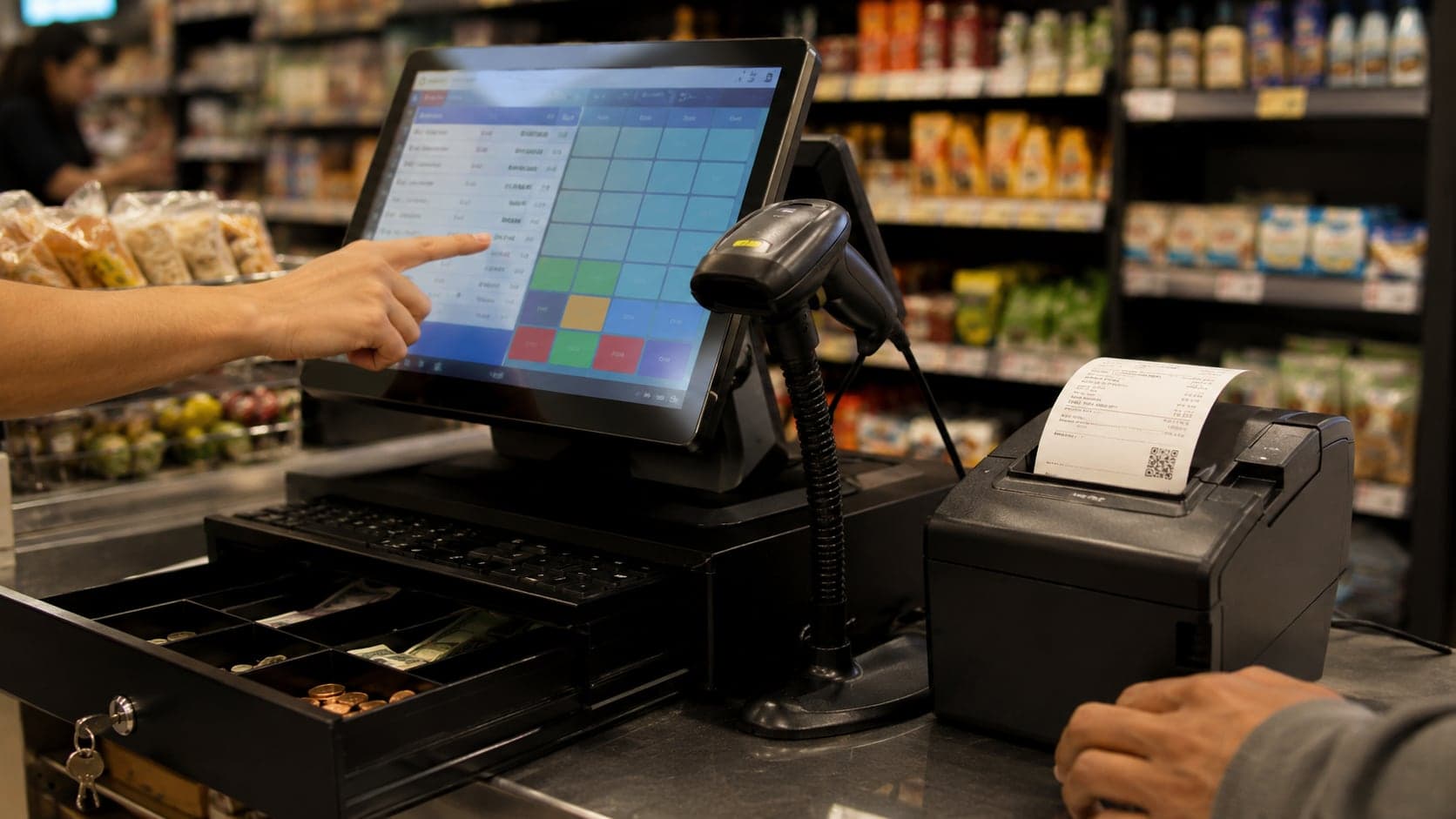
At minimum for inventory control: map each fast-moving SKU to its code, scan at sale so stock deducts automatically, and use the same scanner during cycle counts. That trio alone closes most of the gap between shelf reality and ledger quantity.
Part 3: Buying from suppliers
Purchase orders protect money at the receiving door — but the full PO lifecycle, three-way matching, and supplier ledger ties belong in a focused write-up. See the purchase order systems guide for the complete workflow from draft PO to payment.
From an inventory perspective, the non-negotiable habit is: no stock enters the ledger without a receiving step tied to a document — even if that document is a simple numbered PO in a notebook at first. Partial deliveries stay open until closed; that visibility prevents double-ordering while goods are in transit.
The storeroom itself: places, not piles
Records describe stock; the storeroom is where the description meets reality, and a chaotic room defeats a perfect ledger. The organising principle is one sentence: every item has a home, and anyone can find it. In practice that means a few unglamorous moves that repay themselves daily:
- Zone the room — fast movers nearest the door at waist height, heavy goods low, slow and seasonal stock high and deep. The shop should never wait while someone excavates.
- Name the locations(shelf A3, rack B1) and, if your system supports it, record each item's location. New staff become useful on day one instead of week three.
- Keep a receiving corner — one marked spot where arriving goods wait until they are checked against the PO and entered. Goods that go straight to shelves skip the checking step forever; the corner makes the discipline physical.
- Rotate at restock: new stock goes behind old, every time, so the oldest sells first — the shelf-level habit that makes expiry write-offs rare instead of quarterly.
- One box for the broken and expired, emptied weekly into the adjustments log. Damage that has a box gets recorded; damage that has no box gets binned silently and becomes mystery shrinkage.
Setting up from zero: a two-week checklist
For a shop moving from “stock is what the shelf says” to working inventory control, in realistic order:
- Days 1–2: List your top 100–200 items by sales, with name, unit, cost, price, and barcode. Ignore the tail for now.
- Day 3: Count those items once, carefully. These counts are your opening stock.
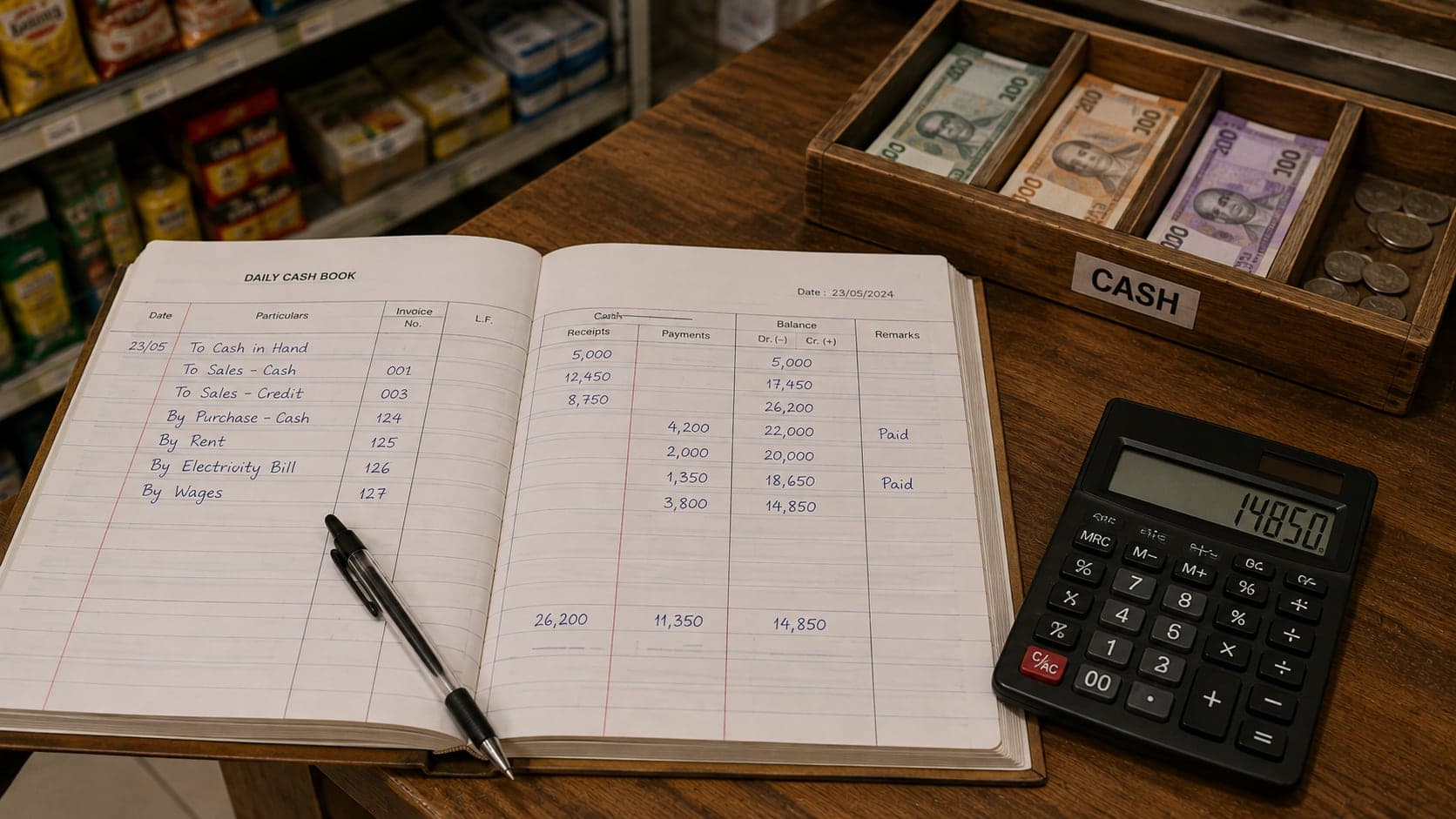
- Days 4–7: Record every movement for these items — sales, deliveries, adjustments. If sales run through a POS, this is automatic; otherwise a ruled register works to start.
- Week 2: Set reorder points for the top 50. Do the lead-time math once per item; write it down.
- Week 2: Start the cycle-count habit: ten items every Tuesday, gaps investigated same day.
- Ongoing: Add the remaining catalog as items cross the counter, issue a PO for every supplier order, and receive against it every time.
Two weeks of this and you will know your shop better than the previous two years of guessing. The habit is the system; software just makes the habit cheap.
FAQ
Frequently Asked Questions
Quick answers to common questions about this topic.
Do I really need software for this, or is a register enough?
The method above works on paper — shops ran it on ledgers for a century. Paper struggles at volume: hundreds of daily sales cannot be posted to stock by hand, which in practice means paper shops track only deliveries and counts, and accept blind spots between counts. Software that deducts stock at the point of sale closes that gap for free. Start with the habit; adopt the tool when volume demands it.
How much stock should I hold overall?
A useful lens is days of stock: shelf value divided by average daily sales at cost. Thirty days means a month of cash on the shelf. There is no universal right number — fast-moving groceries might target two weeks, slow trades two months — but tracking the number monthly shows you the trend, and the trend is what quietly strangles or frees your cash.
What about products with expiry dates?
Add two habits: rotate physically (new stock behind old — the "first expiring, first out" shelf rule) and check dates during cycle counts, flagging anything within its last quarter of life for discounting. Expiry written off in the adjustments log is a measured cost; expiry discovered by a customer is a reputation cost.
How do I count stock without closing the shop?
Cycle counting exists for exactly this: small slices, counted in the quiet first hour, while a colleague handles the occasional customer. For the annual full count, shops that cannot close use the freeze method — count section by section in the early morning across a week, taping off each counted section's restocking until its numbers are entered, and letting the system's movement records bridge the days. Less tidy than a closed-door count, far better than never counting.
What about goods sold loose — by weight, length, or cut?
Track them in their natural unit (kilograms, metres) and accept honest imprecision: spillage, trimming, and scale rounding mean loose goods drift faster than packaged ones. Count them more often, expect small adjustments, and watch the percentage rather than the grams. If a loose item's drift is consistently one-directional and large, that is not physics — that is a process or honesty problem wearing a physics costume.
My supplier will not accept formal POs. Now what?
The PO is for you, not them. Write it anyway, read the order to them from it by phone, and check the delivery against it at the door. The protection comes from the written record and the receiving discipline, not from the supplier's signature.