Purchase Order Systems for Shops: Ordering and Receiving
A purchase order is a promise on paper — what you asked for, from whom, at what price, and when you expect it. Shops that order by phone and memory pay more than they notice: duplicate cartons, wrong sizes, invoice surprises, and stock records that never match the storeroom. This guide walks through the full PO lifecycle, receiving discipline, invoice matching, partial deliveries, and the reorder habits that keep shelves stocked without tying up cash.
Why purchase orders protect your money
Informal ordering feels faster — a WhatsApp voice note, a nod at the weekly van visit, “same as last time.” Speed is real; the costs are just deferred:
- Wrong goods stay your problem. Without a written order, disputing a wrong case size or flavour becomes your word against theirs — and you often sign for the delivery anyway because the truck is blocking the lane.
- Duplicate orders fill the storeroom.Two staff members both “ordered rice Tuesday” because nobody logged the first call. Cash sits in duplicate bags until a promotion clears it at a loss.
- Invoice shock at month end. Per-piece prices drift, promotional credits never arrive, freight appears as a line you did not expect — all harder to challenge without a PO reference the supplier also saw.
- Stock records never reconcile. Goods arrive without a matching inbound record; someone adds quantities by guess after closing. The inventory count diverges, and nobody knows whether the problem is theft, waste, or unrecorded deliveries.
A purchase order system does not require enterprise software or a procurement department. It requires a numbered document (even a duplicated book from the stationer), a habit of writing before ordering, and receiving goods against what was written. The PO is how a shop proves to itself — and sometimes to a supplier or accountant — what was supposed to happen before reality arrived at the loading bay.
The PO lifecycle: draft to payment
Treat every order as moving through six states. Skipping states is how informal shops lose control:
- Draft. Someone identifies need — low stock alert, customer pre-order, seasonal build-up. Lines go on the PO with product, quantity, unit, agreed or expected price, and delivery date. Drafts can wait for approval; they should not be sent accidentally.
- Approved / sent. A named approver confirms the order fits budget and is not a duplicate. The PO number is issued; the order goes to the supplier by whatever channel you use — email PDF, messaging app photo, fax if you still live in 1998. The sent date matters for chasing late deliveries.
- Acknowledged. Ideally the supplier confirms receipt and availability. In practice many skip formal acknowledgement; your fallback is the sent timestamp plus a follow-up call if goods do not arrive by the promised date.
- Partially or fully received. Goods arrive; receiving staff check against the PO, note variances, update stock. Partial receipts keep the PO open with remaining quantities shown — critical for backorders.
- Invoice matched.The supplier's bill arrives; someone compares line items, quantities, and prices to the PO and receiving record. Discrepancies are chased before payment, not after.
- Closed / paid. Payment posts to the supplier ledger in your accounts; the PO closes with all lines received or formally cancelled. Closed POs should not accept new receipts.
Software automates status transitions; paper needs a visible board or folder — open orders in front, closed in back. The architecture matters less than everyone knowing which state an order is in before adding another line to next week's van list.
Writing a purchase order that works
A PO that survives contact with a busy supplier includes more than product names:
- Unique PO number and date. Sequential numbering (PO-2026-0142) beats dates alone — two orders on the same day need two numbers. Never reuse a number, even if the first order was cancelled; mark cancelled POs as such in the register.
- Supplier identity.Legal name, contact person, phone, delivery address if you have multiple sites. Wrong-branch deliveries happen when addresses live only in someone's head.
- Line-level detail.SKU or supplier code, description plain enough for the warehouse picker, quantity, unit (piece, carton, kilogram), unit price, line total. “10 × soap” is an argument waiting to happen; “10 cartons × 24 × 100 g Brand X herbal soap, code HX-100” is an order.
- Expected delivery date and terms.“By 12 Sept” or “with Thursday run” — vague timing produces vague arrivals. Payment terms (cash on delivery, 15 days, etc.) belong here if not fixed in a standing agreement.
- Notes for substitutions.“No substitution” or “substitute only with prior call” saves grief on promotional swaps you cannot sell.
Standing orders deserve their own pattern: a template PO for weekly bread or milk with fixed lines you adjust quantity on, rather than reinventing the document from scratch. Templates reduce errors; they do not remove the need to read before send.
Receiving goods at the door
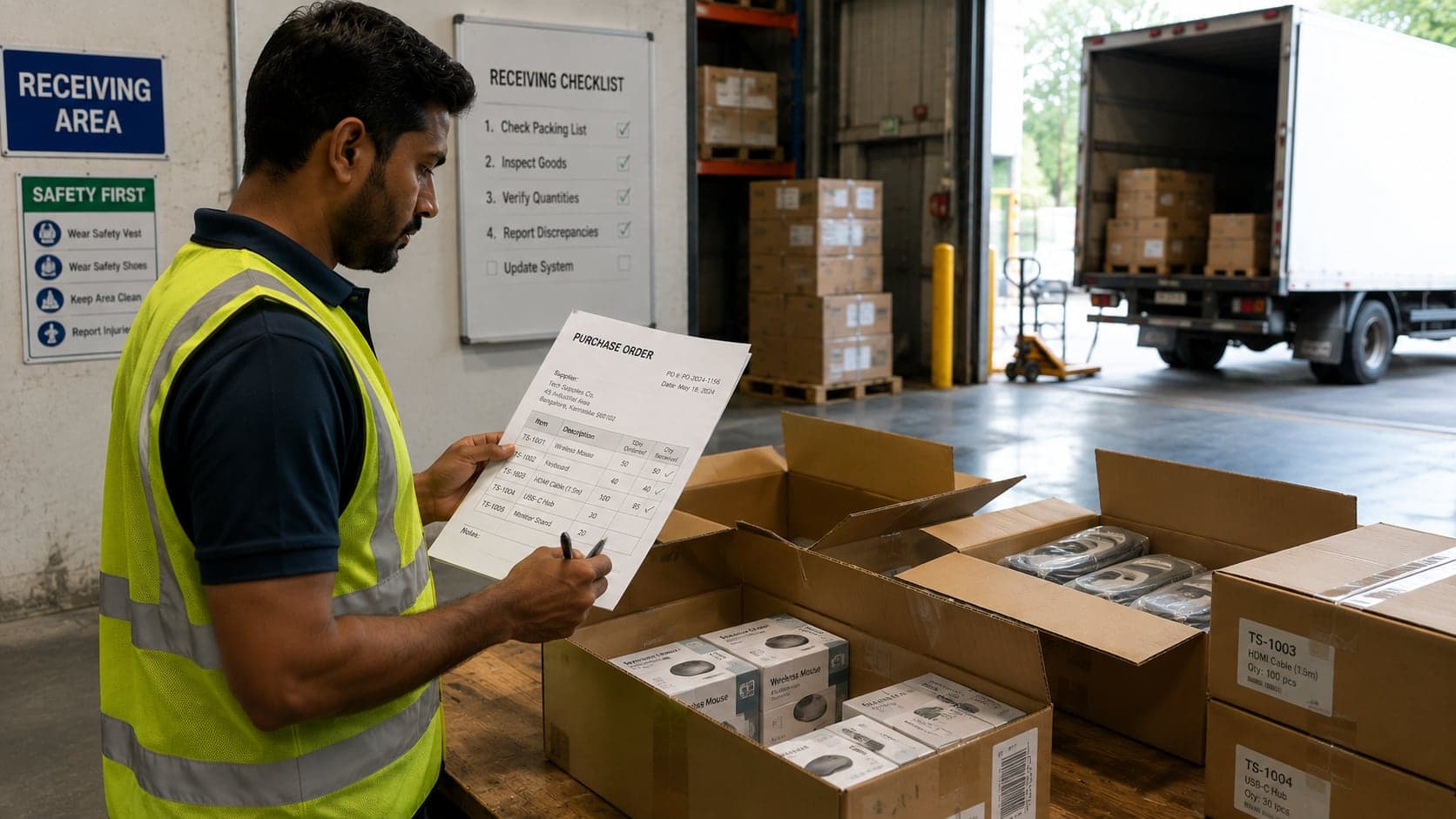
Receiving is where purchase orders earn their keep. The delivery person is present; the goods are visible; your leverage is highest. A receiving routine that fits a small shop:
- Pull the open PO before opening cartons.Know what should arrive — line counts, not just “something from Khan Traders.”
- Count and inspect before signing.Open at least one carton of each line if seals allow; check damage, expiry on dated goods, and variant labels. Signing “received in full” on the driver's sheet without checking is an irrevocable gift to anyone who short-shipped you.
- Record variances on the spot. Shortages, overages, wrong items — note on the delivery copy and on your PO receiving slip. Photograph damaged goods if you expect credit; memory fades faster than pictures.
- Post stock inbound immediately. Quantities enter the inventory system (or stock ledger) the same day, linked to the PO number. Delayed posting is how shelf and screen diverge.
- File the signed delivery note. Clip it to the PO or scan it. Three-way matching below is impossible if the receiving evidence lived only on the back of a cigarette box.
If you use barcodes, scan inbound lines against the PO where software supports it — the barcode guide covers scanner setup. Scanning is optional; counting with eyes and ticking a printed PO is still vastly better than trusting the invoice later.
Matching supplier invoices
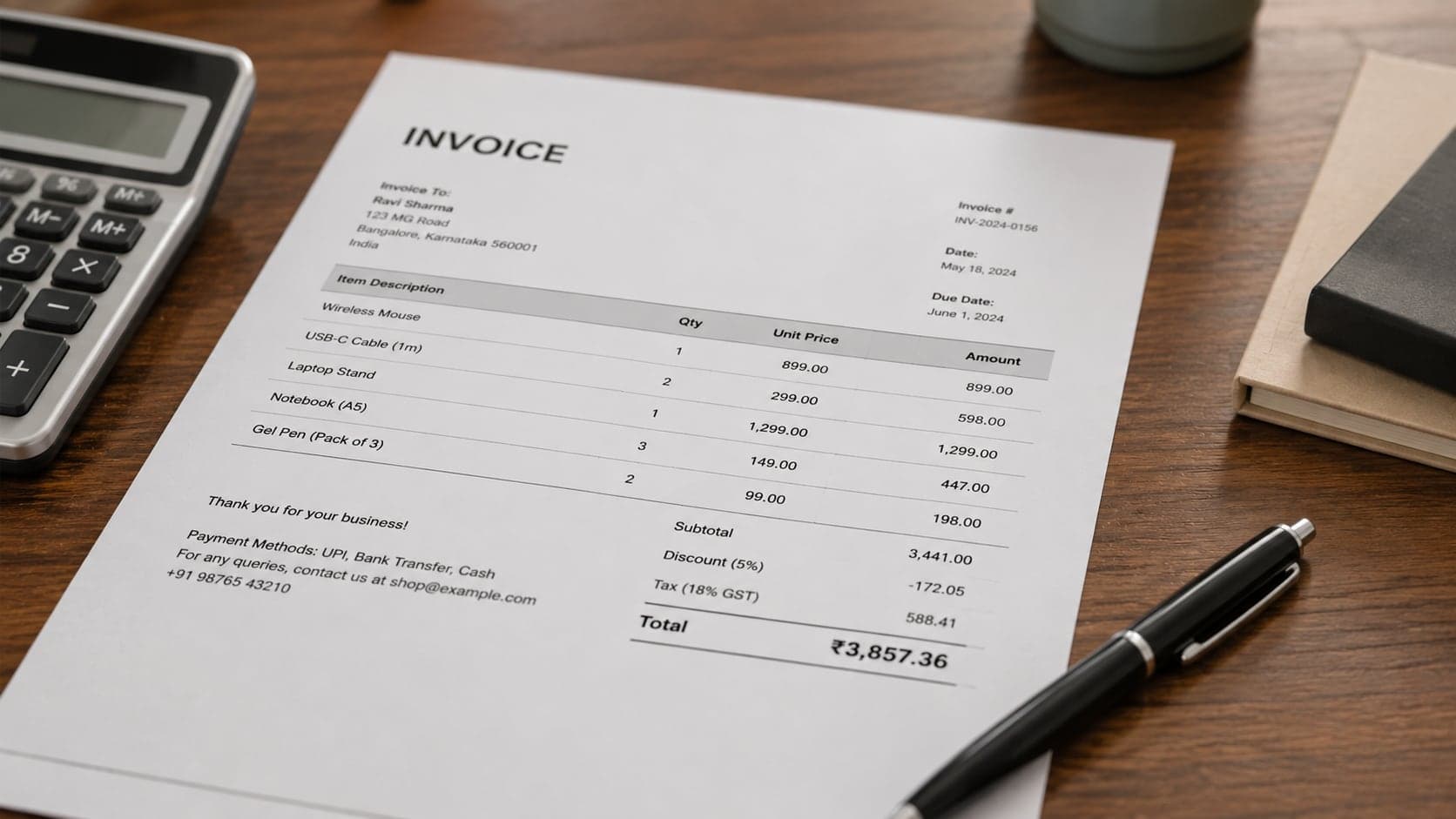
Payment without matching is how shops overpay quietly for years. Three-way matching is the standard: compare purchase order (what you ordered), receiving record (what arrived), and supplier invoice (what they bill). All three should agree on quantity and price per line before money leaves.
Practical matching for a shop without a finance team:
- Match PO number on the invoice. Suppliers should reference your PO; if they do not, match by date and line content manually and ask them to include PO numbers next time — it saves both sides.
- Accept only invoiced quantities received.If you ordered twenty, received eighteen, the invoice should bill eighteen unless backorder paperwork says otherwise. Paying twenty on the invoice because “they will send the rest” without a documented backorder is a loan to your supplier.
- Check unit prices against the PO. Small per-carton drift adds up across hundreds of lines a year. Catch it on the first invoice at the new price, not at year end.
- Separate freight, levies, and credits. These belong as their own lines with plain descriptions. Bundling mystery charges into product cost corrupts your margin analysis.
- Post to the supplier ledger. The invoice increases what you owe; payment decreases it. Your invoicing habits facing customers apply in reverse here — document, number, file.
When all three documents agree, approve payment. When they disagree, hold payment on the contested lines and call — same day if possible. Suppliers respect shops that pay fast after matching; they remember shops that pay without looking and eventually stop fixing errors in their favour.
Partial deliveries and backorders
Real supply chains arrive in pieces — half the PO today, the rest next Thursday, one line permanently unavailable. Partial deliveries done badly double-count stock or pay for goods never received.
Keep the PO open with received quantities shown. Line one: ordered 50, received 30, outstanding 20. Software does this automatically; on paper, write remaining figures in the margin and transfer to a clean sheet if the mess becomes unreadable.
Invoice per shipment or per full order — know which. Some suppliers invoice each delivery; others invoice the full PO at first shipment and adjust on backorder. Either works if you match each invoice to what physically arrived that day. The failure mode is paying a full PO invoice when only partial goods sit on the shelf.
Decide cancelled-backorder lines explicitly. If the remaining twenty will never come, close that line on the PO with a note — supplier cancelled SKU, substituted elsewhere, customer demand died — so nobody expects ghost stock forever.
Customer impact. If you pre-sold against incoming PO lines, partial receipts mean partial promises kept. Tie customer deposits to supplier PO lines where possible so a supplier failure does not become your refund problem from unrelated cash.
Reorder workflows that actually run
Purchase orders should not appear only when the shelf is already empty. A reorder workflow connects stock levels to PO drafts before customers notice:
Reorder point per line.For each regular SKU, the quantity that triggers an order — often expressed as “when on-hand hits X, order Y.” X comes from lead time and daily sales; Y from case pack and shelf capacity. The inventory guide covers the arithmetic; the PO system is where the alert becomes a draft document.
Review bucket weekly. Even with automatic alerts, a human should scan suggested orders once a week — merge supplier shipments, drop lines with pending POs already open, bump seasonal items. Automatic without review duplicates; review without alerts reacts too late.
Supplier cadence calendar. If Khan Traders delivers only Tuesdays, batch POs to Mondays. Emergency orders outside cadence pay rush fees or idle stock — note which SKUs truly need mid-week exceptions versus which could wait if someone had looked at the calendar.
Budget cap optional but useful. A weekly purchasing ceiling prevents a reorder report from draining the bank account during a promotion month. Cap forces prioritisation — fast movers first, slow movers wait — which is healthy when cash is finite.
Software with low-stock alerts and one-click PO generation is worth evaluating when open PO count exceeds what a clipboard can hold; the buyer's guide lists questions to ask about purchasing modules specifically.
Formal POs versus informal ordering
Not every supplier relationship needs a multi-page PDF. Match formality to risk:
| Situation | Minimum control | Why |
|---|---|---|
| Daily bread, fixed price | Standing weekly quantity note | Low variance, high trust, easy dispute |
| Monthly wholesale restock | Full numbered PO | Many lines, price drift, delivery notes |
| Cash market purchase | Written line list before leaving shop | No invoice until you create your own record |
| Imported / high-value equipment | Formal PO + written terms | Disputes are expensive; specs matter |
| Emergency same-day refill | Retroactive PO same day | Speed first, but never skip documenting |
Informal ordering fails when variance and value both rise — many different lines, changing prices, multiple staff ordering, credit terms on the ledger. Formal POs fail when they become theatre — printed but never checked at receiving, or so slow that staff bypass the system entirely. The workable middle: always write the order before goods or money move; use full PO numbers when complexity warrants; allow lightweight notes for trusted daily supply; never sign for delivery without comparing to what was written, regardless of format.
When things go wrong
A short playbook for the arguments POs exist to simplify:
- Supplier bills for goods you never received. Pull receiving record and signed delivery note. No signature, no payment on that line. Escalate with PO copy attached.
- Wrong goods delivered but invoice matches the PO. You ordered correctly; they picked wrong. Reject or accept with documented return/credit note; do not pay for goods you cannot sell unless credit is explicit.
- Duplicate PO sent twice. Catch at acknowledgement or receiving — return or store unopened if returnable; absorb if not. Fix process: who approves, shared open-PO list visible to all orderers.
- Price on invoice higher than PO with no warning. Hold payment on difference; reference prior PO price and date. Persistent drift may mean list prices changed — update your product cost records when resolved, or margin lies on the shelf.
- Goods received but PO was never written.Retroactive PO marked “after fact” for audit honesty, then normal matching. Use as training moment, not standard procedure — retroactive paperwork is how fiction enters the system.
Every incident closed with a one-line note in the supplier file — “Sept 2026: short 2 cartons line 4, credited on INV-8821” — builds the memory institutional staff rotation would otherwise erase.
A specimen order from alert to payment
Follow one line through the system: a hardware shop sells wall paint in five-litre cans. Reorder point is twelve; lead time four days. On Monday morning stock hits eleven — alert fires. The owner reviews the weekly bucket, confirms no open PO already covers paint, and drafts PO-2026-0318: four cartons, eight cans each, supplier code WP-5W, agreed price 2,400 per carton, delivery requested Thursday.
Monday afternoon the PO is sent by message with a PDF photo; Tuesday the supplier replies “confirmed, Thursday truck.” Thursday the delivery arrives: three cartons plus a backorder note for one carton next week. Receiving counts twenty-four cans, checks cans for leakage, notes partial on the driver sheet, scans barcodes inbound, updates stock from eleven to thirty-five. PO stays open with one carton outstanding.
Monday next week the final carton arrives; receiving closes the line. Invoice INV-44102 arrives Tuesday for four cartons at 2,400 — matching fails because only three were billed on the first invoice… except the supplier split billing: INV-44098 for three cartons Thursday, INV-44102 for one carton today. Matcher links both to PO-2026-0318, totals agree, payment posts Wednesday to the supplier ledger. Stock, PO, and cash tell the same story — not because the shop is large, but because each step wrote something down before the next step trusted memory.
That is purchase order discipline in miniature: write before order, check at the door, match before pay, close when done. Formal or informal channel, the sequence stays the same — and shops that keep it sleep better when the month-end supplier statement arrives.
FAQ
Frequently Asked Questions
Quick answers to common questions about this topic.
My supplier ignores PO numbers on invoices. Should I still use them?
Yes. The PO is primarily your control document — it tells your staff what to expect, gives receiving a checklist, and gives you a reference when the invoice arrives. Suppliers who work informally still deliver against something; make that something written on your side even if they never stamp it.
How many open POs should a small shop have at once?
As many as you have outstanding orders, but each should have a clear status: draft, sent, partially received, closed. Shops get into trouble when old POs stay "open" forever and new staff treat them as current authority. Close or cancel POs when the order is fully received or abandoned — a five-minute monthly review prevents chaos.
Do I need a PO for cash-on-delivery purchases?
A lightweight PO still helps: even a one-line internal note with expected quantity and agreed price protects you at the door when the total differs from what was quoted on the phone. Full formal PO paperwork matters less than the habit of writing the order before money changes hands.
Who should approve purchase orders in a small shop?
At minimum, one named person who sees every order before it is sent — usually the owner or a trusted manager. Delegation is fine for repeat stock lines under a spending cap; anything unusual in price, quantity, or supplier should need a second pair of eyes. The goal is preventing duplicate orders and impulse buys disguised as restocking.
What if the invoice price is lower than the PO — do I still pay the PO amount?
Pay what the invoice states after you verify it matches agreed terms — if the supplier honoured a discount or corrected an error downward, accept it. Paying an inflated PO amount because "that is what we ordered" is as sloppy as paying an inflated invoice without checking. Match documents; pay the truth.
Can purchase orders help with customer pre-orders?
The same structure works facing customers: a written order with item, quantity, price, deposit, and expected date protects both sides. It is not a supplier PO, but the discipline — document before delivery, receive against document — is identical. Many shops use one numbering series for supplier POs and another for customer orders to avoid confusion.