
Laptop and Phone Prices Are Climbing, and This Time Waiting for a Sale Is the Losing Move. Here's How to Buy Smart in the Memory Shortage

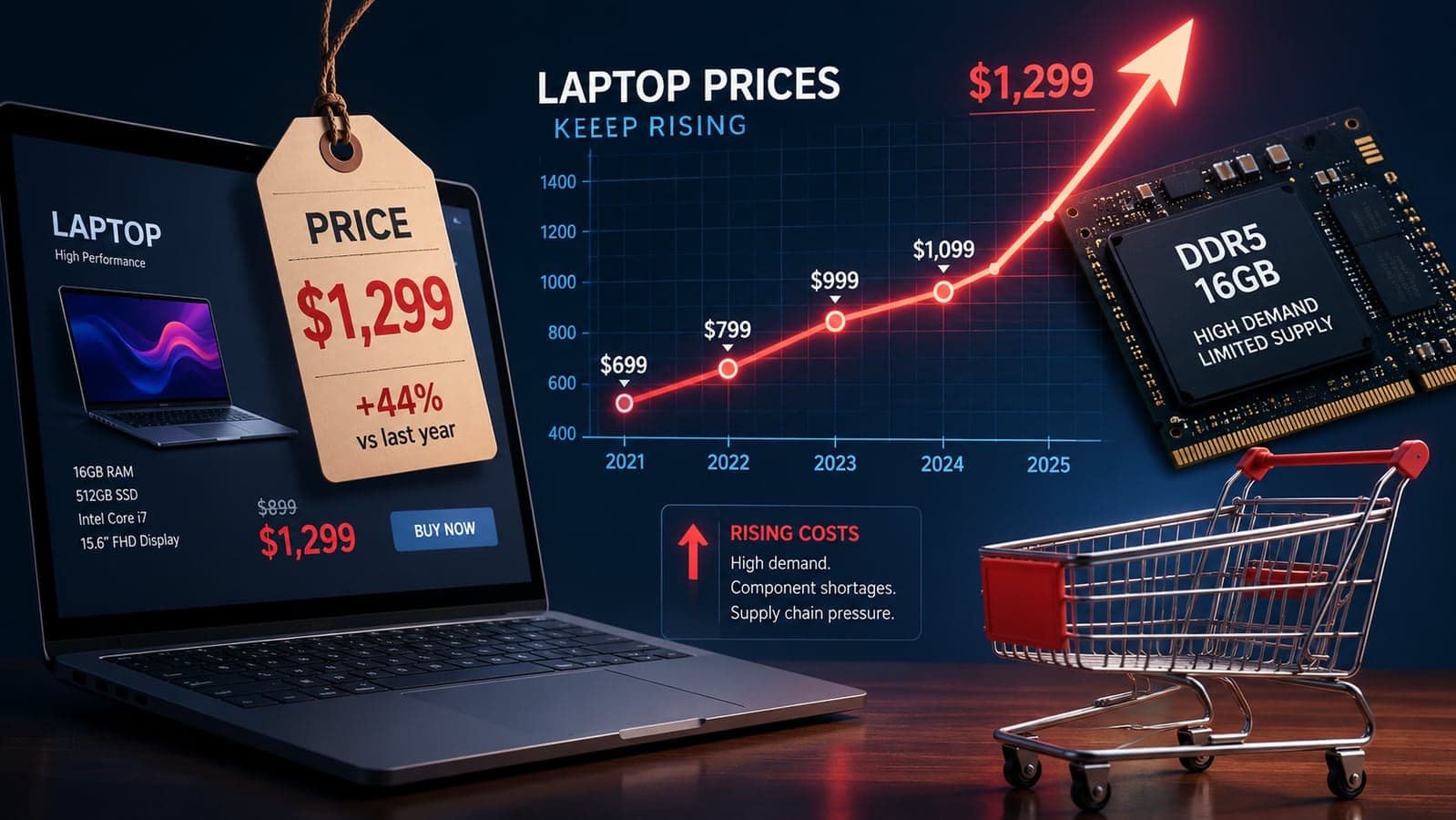
Every experienced buyer carries the same rule around: never pay full price for electronics, because a sale is always coming. Wait for the season-end clearance, the holiday event, next year's model pushing this year's down the shelf. It has been reliable advice for two decades.
In 2026, for anything with memory inside it — which is to say laptops, phones, tablets, and desktop PCs — that rule has quietly inverted. The machines sitting in shops right now were assembled months ago, with memory bought at prices that no longer exist. The machines that replace them on the shelf will be built with memory that costs two to four times as much. For once, the calendar is working against the patient shopper.
This isn't a sales pitch dressed up as news. It's a supply problem with numbers attached, and the numbers come from sober places.
What actually happened to memory prices
RAM — the working memory in every computing device — was for years one of the cheapest components in the box. That ended abruptly. The BBC reported that RAM prices have more than doubled since October 2025, and on the DIY side the move is starker still: a 32 GB desktop memory kit that sold for $80–120 last year was tracking around $439 by mid-June, per the hardware site Notebookcheck — a three- to four-fold jump in a single year.
For a while this stayed a hobbyist problem, painful only for people building their own PCs. It has now reached everything:
- HP told investors that memory now makes up about 35% of a PC's component cost, up from 15–18% just two quarters earlier. When a third of the machine's cost doubles, the sticker price cannot stand still.
- Notebookcheck reports that Dell, Lenovo, Acer, and ASUS have raised prices by 15–30%, with mid-range laptops that used to sell for $900 climbing past $1,200.
- Gartner projects PC prices up roughly 17% and smartphone prices up around 13% for 2026. Analysts told the BBC a typical 16 GB laptop costs $40–50 more to manufacture this year, and a typical smartphone about $30 more — costs that they expect to be passed straight to buyers.
- IDC's market analysis expects the sharpest pain at the cheap end of the market, where margins are too thin to absorb anything — meaning budget devices will either cost more or quietly ship with less inside.
That last point deserves emphasis, because it's the sneaky one. The shortage doesn't only raise prices; it degrades what a given price buys. Notebookcheck has documented the return of 8 GB laptops — a spec the industry had all but retired — now reappearing at price points where 16 GB was recently standard. The discount badge on the shelf tag may be real while the machine under it has been hollowed out.
Why this is happening (and why it won't end soon)
The short version: artificial intelligence ate the memory supply. The data centers being built for AI consume enormous quantities of high-bandwidth memory, and the handful of companies that manufacture memory chips have shifted production capacity toward those buyers, who order in volumes and at prices no laptop maker can match. Less capacity for ordinary RAM plus unrelenting demand equals the price chart everyone is now staring at.
The uncomfortable part is the timeline. New chip factories take years to build and qualify. Supply-chain analysts at TrendForce don't expect meaningful relief before late 2027, possibly stretching into 2028, because that's when new fabrication capacity actually reaches volume production. Gartner's projection has memory and storage prices surging through year-end. Whatever this is, it is not a blip that a patient shopper can simply out-wait.
One honest caveat: forecasts are forecasts. If device prices rise far enough, buyers will balk, demand will sag, and prices could soften somewhat — there were small signs of that in European retail data this summer. But "prices might stop climbing quite so fast" is a different bet from "prices will return to 2025 levels," and nobody credible is making the second one.
So who should actually buy now?
Not everyone. The honest decision tree is short:
- You need a device in the next six to twelve months — a student laptop, a replacement for a dying machine, new computers for staff: buy sooner rather than later. Today's shelf stock was built with cheaper memory; replacement stock is repriced. Waiting for a late-season sale this year means choosing from the more expensive batch.
- Your current device works fine and the upgrade is a "want": keep your money. A working machine you already own is the one purchase the shortage can't touch, and discretionary upgrades are exactly what's worth deferring in an expensive market.
- You're somewhere in between — the laptop is slow but alive: try the free fixes first (clearing storage, trimming startup programs, a fresh OS install). If it's genuinely inadequate rather than merely tired, that's a "need," and the first rule applies.
The one spec line that matters: read the RAM before the discount
If you do buy this season, the single most consequential habit is checking the memory line before anything else on the tag. Three practical rules:
- Treat 16 GB as the floor for a laptop you want to keep for years. Most modern laptops have memory soldered to the board — the amount you buy on day one is the amount the machine dies with. An 8 GB machine that feels adequate today is the machine that gets replaced early, and replacing early in a rising market is the most expensive path of all. This matters double if you want the option of running AI models locally, where memory is the spec that decides everything.
- Judge configurations, not model names or percentage-off claims. The same model name now ships in quietly downgraded configurations. "30% off" an 8 GB machine is a worse deal than full price on a 16 GB one you'll keep twice as long.
- Give certified refurbished a serious look. Refurbished machines were built — and priced — before the squeeze. A one-year-old business-grade laptop with 16 GB, bought from a proper refurbisher with a warranty, is arguably the best value in the entire 2026 market.
If you run a business, this collides with a deadline you already have
Here's the collision most small businesses haven't noticed. If you're still running Windows 10 machines, the commercial security-update deadline lands October 13 — we walked through the details and pricing in our Windows 10 guide — and the standard advice has been to replace aging, ineligible PCs on your own schedule. The memory shortage just repriced that schedule. Fleet replacements postponed to 2027 will very likely cost more per machine than the same purchase made this quarter.
Three moves worth making this month:
- Count and decide now. List every machine due for replacement in the next year, and pull the purchases forward where the case is clear. A 17% price rise on ten laptops is real money for a small firm.
- Budget honestly for 2027. If hardware inflation runs through next year, the IT line in your budget needs to know that now, not at renewal time.
- Question whether every workstation needs to be new and powerful. Work that happens in a browser — dashboards, cloud tools, point-of-sale — runs perfectly well on modest or refurbished hardware. That's precisely why we built Tillqorin, our POS platform, to live entirely in the browser: the till doesn't care whether the machine under it is new, old, or a cheap tablet. The fewer jobs that demand expensive hardware, the less this shortage costs you.
Phones: the same story, six months behind
Smartphones carry the same memory inside, so the same arithmetic applies — IDC puts memory at 15–20% of a mid-range phone's build cost and expects average prices to rise 3–8% depending on how long the shortage runs, with the low end hit hardest. The practical translation: if your phone needs replacing soon, this autumn's models will be better value than waiting for next spring's, and the budget segment is where corners will be cut first. A phone that works fine, as with laptops, remains the best deal available.
The short version
- Memory prices have more than doubled since October 2025 because AI data centers absorbed the supply; analysts don't expect real relief before late 2027.
- That inverts the usual advice: current shelf stock was built with cheap memory, so buying sooner beats waiting for a sale — if you genuinely need a device.
- If your current machine works, the smartest move is keeping it. Discretionary upgrades are what to skip in this market.
- When buying: 16 GB of RAM is the floor, judge the configuration not the discount, and consider certified refurbished — it was priced before the squeeze.
- Businesses: pull forward the replacements you already know are coming (especially Windows 10 machines facing the October deadline), budget for hardware inflation in 2027, and move browser-friendly jobs onto cheaper hardware.
Planning a fleet refresh, a Windows 10 exit, or a shop setup and unsure what actually needs new hardware versus what can run on what you own? That sorting exercise — need it, defer it, downgrade it — is something we work through with clients in an afternoon. Send us a note and we'll help you spend where it counts and skip where it doesn't.
Figures checked on August 20, 2026 against BBC reporting on memory prices, HP's investor statements and Notebookcheck's pricing coverage, Gartner and IDC market projections, and TrendForce supply forecasts. Prices and projections in a shortage move quickly — treat specific numbers as a snapshot, and check current configurations and prices before any large purchase.
FAQ
Frequently Asked Questions
Quick answers to common questions about this topic.
Why are laptop and phone prices going up in 2026?
A global shortage of memory chips (RAM). The data centers built for AI consume enormous amounts of memory, and manufacturers have shifted production toward those high-volume buyers, leaving less supply for ordinary devices. The BBC reports RAM prices have more than doubled since October 2025, HP says memory has grown from roughly 15–18% of a PC's component cost to about 35%, and Gartner projects PC prices rising around 17% and smartphone prices around 13% in 2026. Those component costs are now being passed on to buyers.
Should I buy a laptop now or wait for holiday sales?
If you genuinely need one within the next year, sooner is better this time. Stock currently in shops was assembled with memory bought at lower prices; the inventory replacing it is built with memory that costs several times more, so late-season "deals" will be drawn from repriced stock. Supply analysts at TrendForce don't expect the shortage to ease before late 2027. The exception: if your current machine works fine, don't buy at all — a discretionary upgrade is exactly what's worth skipping in a rising market.
How much RAM should a laptop have in 2026?
Treat 16 GB as the minimum for a machine you intend to keep for several years. Most modern laptops solder memory to the board, so it can never be upgraded — the amount you buy on day one is permanent. The shortage has pushed manufacturers to quietly revive 8 GB configurations at prices where 16 GB was recently standard, so check the memory line before the discount percentage. An 8 GB bargain that needs replacing in two years costs more overall than a 16 GB machine at full price.
Are refurbished laptops a good idea during the memory shortage?
Yes — arguably the best value in the 2026 market. Certified refurbished machines were manufactured and priced before memory costs spiked, so a one-year-old business-grade laptop with 16 GB of RAM, bought from a reputable refurbisher with a warranty, often beats a new machine with a weaker configuration at the same price. Buy from established refurbishment programs rather than unknown marketplace sellers, and confirm the battery condition and warranty terms.
When will RAM and device prices come back down?
Not soon, according to the supply-chain analysts who track chip manufacturing. New memory factories take years to build, and TrendForce doesn't expect new capacity to reach volume production before late 2027, possibly 2028. Prices could stop climbing sooner if expensive devices dampen demand — there were mild signs of that in European retail this summer — but no credible forecast has prices returning to 2025 levels in the near term. Planning around today's prices is the realistic approach.
What should small businesses do about rising computer prices?
Three things. First, count every machine due for replacement in the coming year and pull clear cases forward — a 17% price rise across a fleet is significant money, and Windows 10 machines face a separate commercial security-update deadline on October 13, 2026. Second, budget for hardware inflation in 2027 rather than being surprised by it. Third, reduce how many jobs need powerful hardware at all: browser-based tools — dashboards, cloud software, web-based point-of-sale — run well on modest or refurbished machines, which shrinks the number of expensive purchases the shortage can touch.

 Tayyab Aslam