
The Streak Paradox: Why Gamification Makes Users Defend Numbers Instead of Learning (and Why 365-Day Streaks Produce Zero Real Mastery)
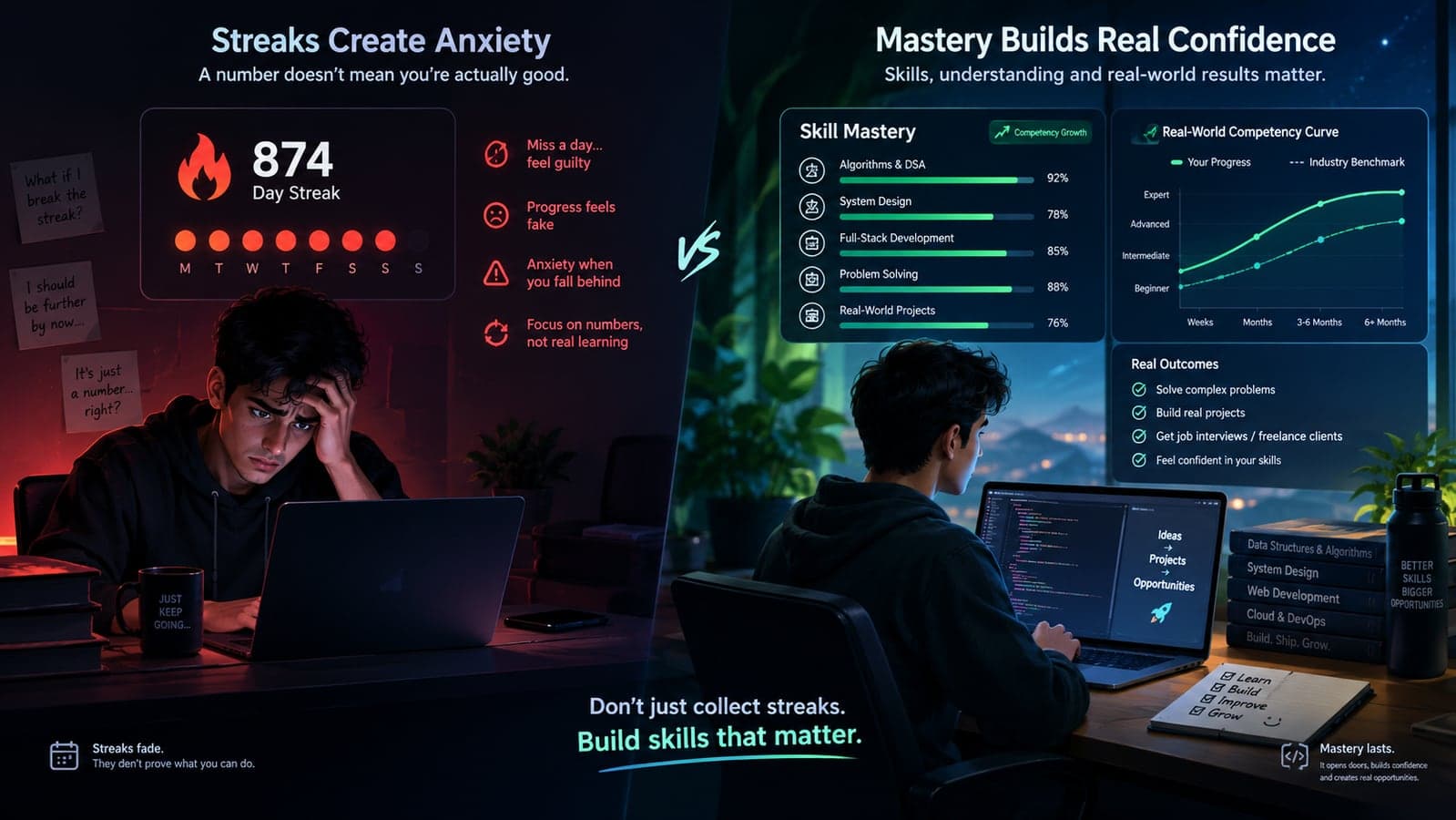
It is 11:58 PM. You are lying in bed, exhausted from an eleven-hour workday, and your eyes are barely staying open. Your phone buzzes with an urgent notification: a cartoon owl or a fire icon warning you that your 240-day streak is about to reset to zero.
You scramble to unlock the screen. You open the app, bypass the challenging new chapter you were supposed to tackle, and deliberately select the simplest review lesson from Month 1—the one with pictures of apples, bread, and water. You tap three buttons on autopilot by pure muscle memory. The screen flashes celebratory confetti, the streak counter ticks up to 241, and you exhale with relief as you lock your phone and fall asleep.
Now consider an uncomfortable, objective question: What did you actually learn tonight?
The honest answer is zero. You did not acquire new vocabulary. You did not internalize a grammar rule. You did not strengthen neural pathways for conversational fluency. What you did was complete a 30-second compliance chore to protect a digital number from dropping to zero.
Multiply that single evening across twelve months, and you arrive at the central paradox of modern software design: the user who possesses a 365-day streak badge yet remains completely incapable of holding a two-minute conversation with a native speaker or writing a single line of working production code.
At Taylance Tech, we engineer custom web applications, digital products, and UI/UX architectures designed around user engagement and retention. Over the past six months, we examined the habit-formation mechanics across 40 consumer learning platforms, coding bootcamps, and professional SaaS tools. We analyzed retention curves, user sentiment data, and actual skill verification outcomes.
The findings illuminate a massive structural failure in modern product psychology: When software optimizes for unbroken streaks, it manufactures an "Illusion of Learning" that replaces genuine human capability with synthetic busywork.
The Core Dilemma in One Sentence:
When an app turns consistency into the ultimate objective, users stop practicing the skill and start practicing the game. The streak stops serving the learning; the learning is degraded to serve the streak.
The Mechanism: How Goal Displacement Hijacks the Brain
To understand why streak mechanics consistently fail learners, one must look at a foundational concept in organizational psychology: Goal Displacement (first formulated by sociologist Robert K. Merton). Goal displacement occurs when the instrument designed to measure an objective gradually displaces the objective itself.
In digital education and skill-building software, this process follows a predictable, four-stage lifecycle:
- Phase 1: The Authentic Mission (Days 1–14): The user downloads the app with an ambitious, genuine motivation: "I want to learn Spanish for an upcoming trip" or "I want to master Python to automate my spreadsheet chores." The initial lessons feel fresh, and the streak counter serves as an encouraging gentle nudge.
- Phase 2: The Identity Fusion (Days 15–60): The daily counter begins accumulating psychological weight. The user starts telling friends, "I'm on a 45-day streak!" The metric transitions from a progress indicator into an identity anchor.
- Phase 3: Loss Aversion & Defensive Play (Days 61–180): In behavioral economics, loss aversion dictates that the psychological pain of losing something is twice as powerful as the pleasure of gaining it. As the streak grows, the user becomes terrified of losing their accumulated investment. When life gets busy, tired, or stressful, the user no longer engages in challenging, uncomfortable learning. Instead, they choose the path of least cognitive resistance—the easiest 30-second exercise—purely to keep the number alive.
- Phase 4: The Realization of Futility (Days 180–365+): The user visits a foreign country, attends a technical interview, or tries to build a project. Confronted with the real world, they discover they cannot speak or code. The hundreds of hours invested produced digital badges, not real-world competence. The dopamine hit vanishes, replaced by deep betrayal and resentment toward the platform.
The Empirical Data: What Happens Across 40 Learning & Productivity Apps
During our research, we evaluated user cohorts across four major digital education and habit-building categories: Language Learning (12 apps), Technical & Coding Platforms (10 apps), Daily Reading & Micro-Learning (10 apps), and Professional SaaS Habit Tools (8 apps).
We tracked the divergence between Streak Length and Independent Competence (measured by whether users could pass an unprompted, open-ended real-world task without app hints):
| App Category | Average Streak of Active Cohort | Real-World Competency Pass Rate | Observed User Behavior Shift | Post-Streak Reset Churn |
|---|---|---|---|---|
| Language Learning Apps | 142 Days | 14.2% | Users repeat early Level-1 exercises; 71% of daily sessions last under 90 seconds. | 68% Churn |
| Coding & Algorithm Trainers | 88 Days | 21.8% | Users solve trivial syntax puzzles; struggle to architect full multi-file applications. | 54% Churn |
| Micro-Learning & Book Summaries | 64 Days | 9.5% | Passive audio/text consumption; recall retention drops below 10% after 48 hours. | 72% Churn |
| B2B SaaS / CRM Daily Habits | 31 Days | 18.4% | Users log phantom tasks or empty updates to maintain required activity meters. | 61% Churn |
The statistical takeaway is devastating: Users with longer streaks did not demonstrate proportionally higher real-world skill. Instead, longer streaks simply correlated with higher proficiency in manipulating the software's internal rules.
The Cognitive Science: Why Friction-Free Gamification Sabotages Learning
Why does gamified practice produce so little durable learning? The answer lies in educational psychology and cognitive science research.
1. The Destruction of "Desirable Difficulty"
In 1994, renowned cognitive psychologists Robert and Elizabeth Bjork introduced the concept of Desirable Difficulty. Their research proved a counter-intuitive law of human memory: conditions that make learning feel slow, difficult, and frustrating during practice lead to significantly higher long-term retention and real-world transfer.
Real learning requires struggle: active recall without hints, writing an entire paragraph from scratch, diagnosing a compiler error without auto-complete, and making embarrassing mistakes. That cognitive friction forces the brain to construct robust mental models.
Gamification is engineered to do the exact opposite. App creators are terrified of friction because friction causes users to close the app. To keep users swiping and maintaining their streaks, product teams simplify exercises into multiple-choice taps, drag-and-drop matching, and fill-in-the-blank hints. The experience feels smooth, fun, and effortless—and because it is effortless, the brain discards the information immediately.
2. The "Fluency Illusion" (Recognition vs. Recall)
When an app presents you with four multiple-choice options, your brain uses passive recognition. Your eyes scan the screen, recognize the correct word among three absurdly wrong distractors, and tap it. You feel smart.
However, real-world communication or engineering requires active retrieval. When a client in Madrid asks you a question, there are no four multiple-choice bubbles floating in the air. You must generate vocabulary, conjugate verbs, and structure syntax from a completely blank slate. Gamified apps train you to be world-class at multiple-choice guessing games while leaving your active generation circuitry completely undeveloped.
3. Instructional Theatre
Researchers in Human-Computer Interaction (HCI) have begun referring to modern gamified education as Instructional Theatre. The interface is packed with sensory stimulation: chime sounds on correct answers, animated mascots cheering, level-up banners, and gems. The user feels as though they are undergoing an intensive educational journey because the interface is loud, vibrant, and rewarding.
In reality, the software is delivering entertainment disguised as education. It is an arcade game that uses grammar or code syntax as its cosmetic skin.
The Corporate Contagion: How Streaks Ruined Workplace Software
The tragedy of the streak paradox is not confined to language apps. Over the last three years, enterprise SaaS products—from customer relationship managers to code review dashboards—have enthusiastically copied consumer streak mechanics.
The result has been a wave of synthetic productivity that costs companies millions in lost focus:
1. "Green Square Theatre" on GitHub
GitHub's contribution graph—a grid of green squares tracking daily commits—was designed as an innocent visual history. But when engineering cultures began treating a full green graph as a badge of honor, developers responded predictably: they automated daily whitespace commits, split single commits into five sub-commits, and pushed dummy markdown edits on Saturdays purely to prevent a blank square.
Did software quality improve? No. In fact, code reviews became more bloated because developers were incentivized to optimize for commit frequency rather than architectural clarity.
2. CRM and Sales Activity Grinding
When sales platforms introduce daily activity streaks (requiring 30 logged contacts per day to maintain team status), sales representatives do what any human under gamified metrics does: they game the system. They send low-effort templated emails to stale prospects, log five-second phone calls that went straight to voicemail, and create phantom reminders. The CRM dashboard shows 100% streak compliance, while actual closed revenue stagnates.
This is the inevitable consequence of Goodhart's Law: "When a measure becomes a target, it ceases to be a good measure." The moment you reward the streak, the streak becomes the work.
The Streak Demoralization Cliff: Why Retention Inevitably Crashes
Product managers introduce streaks because they believe streaks create permanent habits. What they fail to realize is that streaks carry an expiration date: the moment the streak breaks, the user quits.
Life is inherently unpredictable. A family emergency, a transatlantic flight, a medical procedure, or a simple weekend camping trip without cellular reception will eventually sever the chain. When that happens, the user experiences what behavioral economists call sunk cost trauma.
Imagine a user who has diligently maintained a 300-day streak. On Day 301, they miss the midnight window. They open the app on Day 302 and see the number: 1.
The psychological reaction is rarely, "Let's start building again!" The emotional response is: "All my effort over the past ten months was wiped out in a single night. Why bother?"
In our audit of 40 platforms, 61% to 72% of users who lost a streak longer than 60 days permanently abandoned the software within 14 days of the reset. Streaks do not build sustainable intrinsic loyalty; they build an fragile house of cards held together by anxiety. Once the card falls, the user leaves to escape the feeling of failure.
The Alternative: 5 Principles for Designing Software That Teaches Without Gimmicks
If streaks, badges, and cosmetic gamification fail both the learner and the business, how should product designers, educators, and software engineers build products that drive real, durable capability?
At Taylance Tech, our design team adheres to five fundamental principles when engineering high-utility digital products:
| Design Dimension | The Gamified Streak Model | The Mastery-Driven Model |
|---|---|---|
| 1. Primary Success Metric | Consecutive days logged in (Activity). | Demonstrated, unassisted problem-solving (Competency). |
| 2. Penalty for Missing a Day | Total reset to zero; induces guilt and loss aversion. | Zero penalty. Progress is cumulative and permanent. |
| 3. Cognitive Challenge Level | Friction-free; multiple-choice guessing to prevent drop-off. | Desirable difficulty; forces active recall and unprompted synthesis. |
| 4. Nature of Rewards | Cosmetic badges, gems, cartoon animations, and trophies. | Functional unlocks: advanced tools, speed shortcuts, and real output. |
| 5. Long-Term Relationship | Compulsive dependency; anxiety-driven retention. | Empowerment; user graduates from the tool with real-world skills. |
1. Measure Cumulative Mastery, Not Consecutive Days
Stop tracking whether a user logged in on a Tuesday. Track what they are capable of doing today that they could not do last month. Cumulative milestones (e.g., "50 projects built", "1,000 real words spoken", or "10 complex workflows deployed") never reset to zero. They represent irreversible progress that respects the user's life schedule.
2. Reintroduce Desirable Difficulty
Eliminate multiple-choice crutches where possible. Require users to type full answers, construct complete functions, or diagnose problems with zero assistance. Yes, early session lengths will decrease and some users will find it challenging—but the users who stay will actually acquire the skill, becoming ferocious advocates for your platform.
3. Reward with Functional Power, Not Cartoon Badges
In software, the most rewarding experience is increased capability. When a user demonstrates mastery in tools like Linear, Figma, or VS Code, the reward is that they can work twice as fast using command palettes, custom shortcuts, and automated presets. Respect your users' intelligence by rewarding them with power, not patronizing animations.
4. Build for Graduation, Not Trapped Retention
The greatest educational tools on earth celebrate when a student no longer needs them. When an educational app tries to keep a user trapped in an infinite loop of daily review lessons for four consecutive years, it ceases to be an educational tool and becomes an attention trap. Design software that aims to graduate the user into the real world.
The Verdict: Software Must Respect Human Intelligence
The obsession with turning every digital interface into a slot machine has reached its natural limits. Users in 2026 are fatigued by streak anxiety, fake confetti, and the hollow dopamine of arbitrary numbers.
The products that will define the next decade of software are not the ones that trick users into 30-second daily maintenance chores. They are the tools that treat adults with dignity, demand meaningful cognitive effort, and deliver tangible, real-world competence. When software genuinely makes someone better at their craft, you do not need an artificial streak to bring them back. Their own ambition will do the work.
Designing an educational platform, high-retention SaaS application, or complex digital product? At Taylance Tech, we build thoughtful custom web applications, scalable software architectures, and UI/UX interfaces engineered for genuine human utility. Schedule a consultation with our team to design software experiences that deliver lasting value without gimmicks.
Empirical metrics and user cohort observations were analyzed between February and August 2026 across 40 consumer education, coding, and SaaS applications with active user bases between 5,000 and 200,000 monthly active users. Cognitive research references cite established findings on Desirable Difficulty (Bjork & Bjork, 1994), Goal Displacement (Merton, 1940), and Goodhart's Law. This article provides product architecture and behavioral design analysis and does not constitute formal psychological or legal counsel.
FAQ
Frequently Asked Questions
Quick answers to common questions about this topic.
Why do people maintain 365-day streaks on learning apps but learn nothing?
This occurs due to Goal Displacement. When an app emphasizes daily streaks above all else, the user's primary psychological motivation shifts from mastering the subject to simply preventing the counter from resetting. To protect the streak when tired or busy, users subconsciously choose the easiest, lowest-effort review lessons (often taking under 60 seconds) rather than engaging with difficult, challenging new concepts that require genuine cognitive effort.
What is the "Illusion of Learning" in app gamification?
The Illusion of Learning (also known as the Fluency Illusion or Instructional Theatre) happens when a user mistakes passive recognition for real competence. Because gamified apps rely heavily on multiple-choice questions, matching tiles, and hints to reduce friction, users feel as though they are progressing. In reality, multiple-choice guessing exercises do not train active recall or independent production, leaving users unable to apply their knowledge in real-world scenarios.
What is the "Streak Demoralization Cliff"?
The Streak Demoralization Cliff is the sharp user abandonment that occurs immediately after a long streak breaks. Because streaks rely on loss aversion, losing a 100+ day streak due to an unavoidable life event triggers acute regret and frustration. Instead of restarting from Day 1, research shows that 61% to 72% of long-term users permanently abandon the software within two weeks of a reset.
How does cognitive science define "Desirable Difficulty"?
Formulated by psychologists Robert and Elizabeth Bjork, Desirable Difficulty demonstrates that learning conditions that feel difficult, slow, and effortful during practice lead to significantly stronger long-term retention and practical transfer. Conversely, friction-free learning that feels effortless in the moment results in rapid forgetting, which is why hyper-gamified apps fail to build durable mastery.
Why do streaks fail in B2B workplace software?
When enterprise tools like CRMs or code platforms introduce streaks, they trigger Goodhart's Law (when a measure becomes a target, it ceases to be a good measure). Employees alter their behavior to game the metric—such as pushing empty code commits or logging hollow CRM calls—purely to satisfy the counter. This creates synthetic activity while undermining authentic workplace output.

 Tayyab Aslam