How to Build a Web App in 2026: Real Cost, Stack & Timeline (From a Founder Who Ships)

We launched Taylance Tech in May 2026 after shipping production projects as a team — including Tillqorin, ToolFusion, and Taylance CRM. Every one of those projects started with a founder asking the same three questions: how much will this cost, what stack should I pick, and how long will it take? This guide is the answer we give — with the actual numbers.
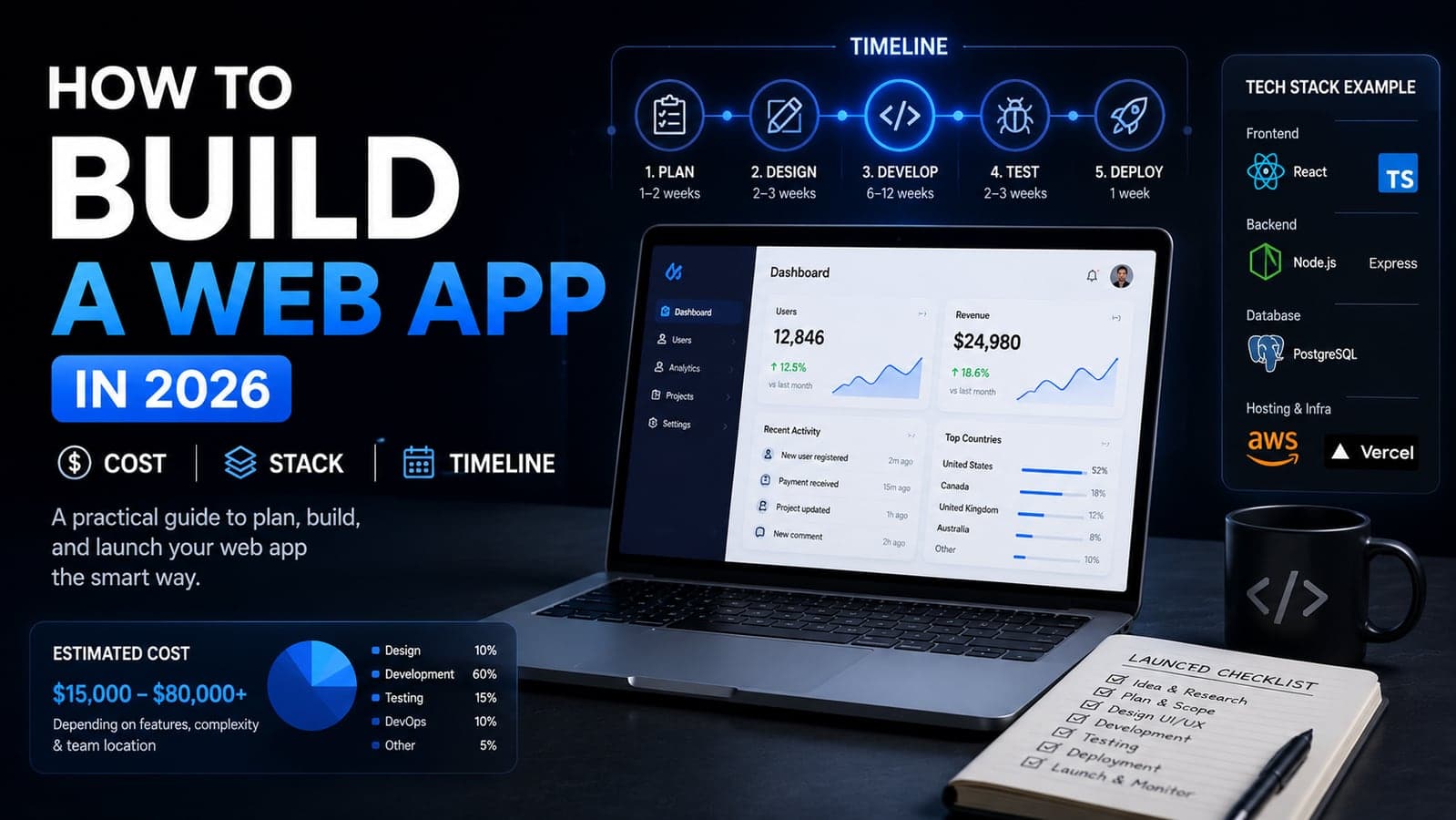
The short version: a production SaaS MVP in 2026 typically costs $1,000–$4,000 and takes 8–16 weeks. A marketing site with a blog runs $4,00–$1,000 over 3–6 weeks. Anyone quoting "any app in 2 weeks" is selling you a prototype, not a product. The rest of this article explains where those numbers come from and how to avoid paying them twice.
Who this guide is for
This is written for startup founders, small business owners, and product teams who need a production-ready web application — not a demo that breaks the week after launch. If you're comparing agencies, freelancers, or an in-house hire, use it as a checklist:
- You want a SaaS MVP, client portal, or internal tool
- You care about SEO, performance, and maintainability
- You need honest timelines and budgets, not sales-call optimism
What "production-ready" actually means in 2026
A production web app is more than a UI in Figma. At minimum it includes:
- Authentication & roles — sign-up, login, password reset, protected routes
- Database & APIs — a validated data layer, not hard-coded JSON
- Deployment — CI/CD, staging + production environments, error monitoring
- Security basics — HTTPS, input validation, rate limits, secure environment variables
- Performance — passing Core Web Vitals, image optimization, caching where it matters
- SEO foundation — metadata, sitemap, structured data, server-rendered indexable pages
Skipping any of these is how projects end up "live" but invisible to Google, slow on mobile, or impossible to extend. We've inherited enough of those codebases to know the cleanup costs more than doing it right the first time.
Recommended tech stack for new web apps (2026)
There's no universal stack. But for most SaaS and marketing-led products, this is what we reach for — and why.
Frontend: Next.js + React + TypeScript
Next.js remains the strongest default for SEO-heavy apps because server rendering and static generation give Google (and now AI search engines) fully rendered HTML instead of an empty JavaScript shell. Google's own documentation recommends server-side rendering or pre-rendering for content you need indexed. TypeScript costs a little speed up front and repays it every time the codebase grows past one developer. This is the stack behind our own web development work.
Backend & database: Supabase, or Node + PostgreSQL
For MVPs, Supabase (PostgreSQL + auth + storage + row-level security) accelerates delivery without locking you into a proprietary backend — it's standard Postgres underneath, so you can eject later. For complex billing logic or custom APIs, Node with a managed Postgres instance still works well. We've shipped with both approaches across our own products, including Tillqorin and Taylance CRM.
Payments & subscriptions
If you sell online, plan Stripe integration early — webhooks, failed-payment handling, and the customer portal, not just the checkout button. When we built Tillqorin's billing and accounts module, the invoice UI came together in days — the edge cases (partial payments, refunds, and keeping the ledger consistent) took weeks. Budget for the weeks, not the days.
AI features (when they add real value)
LLM features belong where they save measurable time — document extraction, scoring, support triage — not as a badge on the pricing page. ResumeForge AI's core value is exactly this: ATS-oriented resume scoring and improvement flows that would take a career coach hours per candidate. See our AI & automation services for the patterns we use in production.
Realistic web app cost ranges in 2026
These ranges reflect founder-led and boutique studio engagements with remote delivery, in USD. Large agencies in the US or EU typically run 2–4× higher for equivalent scope; solo freelancers can be lower but concentrate all delivery risk in one person.
| Project type | Typical scope | Indicative budget | Timeline |
|---|---|---|---|
| Landing + lead capture | 5–8 pages, CMS or static, SEO setup | $2,000 – $6,000 | 2–4 weeks |
| Marketing site + blog | Content system, admin, analytics | $4,000 – $10,000 | 3–6 weeks |
| SaaS MVP | Auth, core workflow, admin, billing | $15,000 – $45,000 | 8–16 weeks |
| Custom internal CRM / ops tool | Roles, dashboards, integrations | $12,000 – $35,000 | 6–12 weeks |
| AI-powered product feature | Model integration, guardrails, UI | $5,000 – $20,000+ | 3–8 weeks (add-on) |
Red flags in quotes: a fixed price with no discovery phase, no mention of hosting or third-party costs, "unlimited revisions," or a portfolio with no live URLs you can click. Good partners scope in phases and define what "done" means per milestone — in writing.
Timeline breakdown: an 8-week SaaS MVP, week by week
- Week 1 — Discovery: goals, users, must-have vs nice-to-have, success metrics
- Week 2 — UX flow: wireframes for the core paths (signup → activation → paywall)
- Weeks 3–5 — Build sprint: auth, database schema, core features, admin basics
- Week 6 — Integrations: Stripe, transactional email, analytics (GA4), error tracking
- Week 7 — QA & performance: mobile testing, Lighthouse, security pass
- Week 8 — Launch: production deploy, monitoring, handoff docs
ToolFusion, our browser-based media editor, shipped on a tight timeline because the problem was defined before code started. In our experience, scope creep kills more timelines than any technology choice does.
SEO: build traffic from day one, not after launch
Many apps launch with a single landing page and zero indexable content — which makes paid ads the only acquisition channel from day one. Instead:
- Publish 1–2 pillar articles targeting the questions your buyers actually search
- Ship sitemap.xml, canonical URLs, and JSON-LD structured data on key pages
- Use semantic HTML — one H1 per page, logical H2/H3 hierarchy
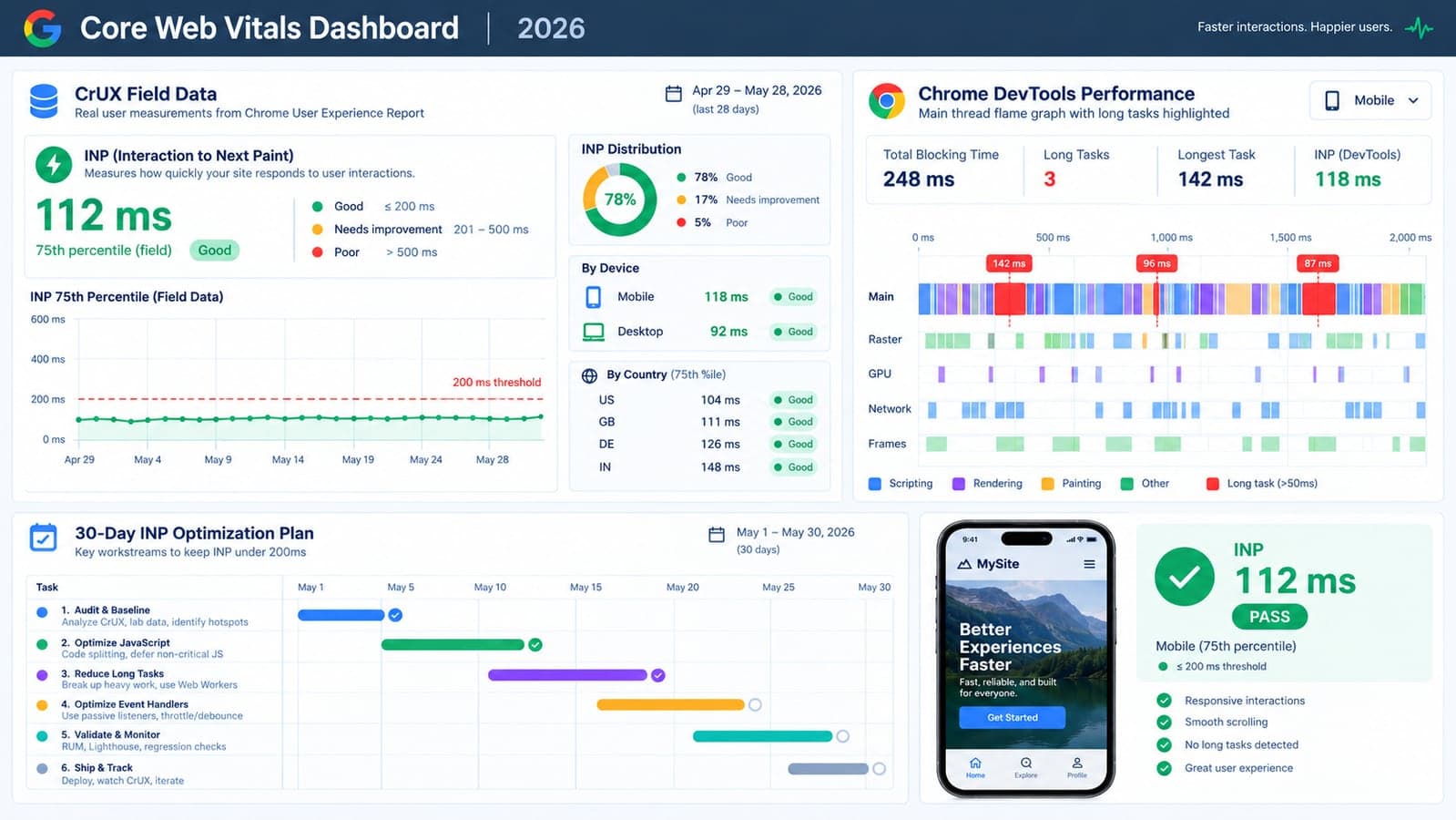
- Keep Core Web Vitals green — page experience is a confirmed Google signal, and fast server-rendered pages are also what AI search engines can read and cite
Our SEO service line focuses on technical SEO plus content that matches buyer intent — not keyword stuffing.
Common mistakes founders make
1. Building every feature before validating one workflow
Ship the smallest loop that proves value. Add dashboards and nice-to-have modules after real usage tells you they're needed.
2. Choosing a stack for résumé appeal
Your stack should optimize for hiring, hosting cost, and delivery speed — not for what's trending on X this month.
3. Ignoring maintenance
Budget 10–20% of the build cost annually for dependency updates, security patches, and small enhancements. An unmaintained app is a slowly accumulating liability.
4. Fake social proof
Testimonials and case studies should reflect real work. Our portfolio links to live apps you can open and test yourself — hold anyone you hire to the same standard.
Founder-led studio vs large agency vs freelancer
Large agencies bring process and bench depth, and charge for both. Freelancers are cheapest but you're one illness or disappearance away from a stalled project. Founder-led studios sit in between: you get direct access to the people writing the code and making architecture calls, without agency overhead. For early-stage products, that direct line usually matters more than process depth — provided the studio has shipped real production apps. Ask for live URLs and a clear statement of exactly who will build your product.
What we're building at Taylance Tech
Taylance Tech is a founder-led studio based in Faisalabad, Pakistan, working remotely with clients worldwide. We design and build web applications and SaaS platforms, AI-powered workflows, and SEO-focused sites that rank and convert. Browse our case studies or start a conversation if you want an honest scope review for your next project.
About the author: Tayyab Aslam is co-founder and lead developer at Taylance Tech. He has shipped multiple production web applications on Next.js, Supabase, and Node — including Tillqorin, ToolFusion, and ResumeForge AI — and has solved 1,000+ algorithm problems on LeetCode. Find him on LinkedIn and thisistayyab.dev.
FAQ
Frequently Asked Questions
Quick answers to common questions about this topic.
How much does it cost to build a web app in 2026?
Most production SaaS MVPs cost $15,000 to $45,000 for a first version with auth, a core workflow, and billing. Marketing sites run $2,000–$10,000. Enterprise integrations and compliance requirements push budgets higher.
How long does web app development take?
A focused SaaS MVP takes 8–16 weeks from discovery to production deploy. Simple marketing sites ship in 2–6 weeks. Timelines slip when scope grows mid-build, not because of the framework.
Is Next.js still good for SEO in 2026?
Yes. Server-rendered and statically generated pages outperform client-only SPAs for organic discovery, and they're also what AI search engines like ChatGPT and Perplexity can reliably read and cite.
Should I hire offshore developers?
Remote teams deliver excellent work when communication, timezone overlap, and code-quality standards are explicit. Judge by track record and live products, not by location.
What should I prepare before contacting a developer?
A one-page brief: the problem, target user, 3–5 must-have features, budget range, desired launch date, and two or three products you like. That single page cuts a week off discovery.

 Tayyab Aslam