Vibe Coding in 2026: When It Works, When It Breaks, and When You Need a Real Developer

Eighteen months ago, "vibe coding" was a phrase in a single tweet. Today, Collins Dictionary's 2025 Word of the Year is the default way most software gets built. 92% of U.S. developers now use AI coding tools daily, and by GitHub's count, 46% of all new code written in 2026 is AI-generated. In February 2026, the term hit its most dramatic milestone yet: a wave of SaaS companies — Box, Smartsheet, Asana, Monday.com — underperformed the broader market because internal teams started replacing $50–200/seat software with tools they vibe-coded themselves over a weekend. Analysts are calling it the "SaaSpocalypse."
So the tool is real, the shift is real, and if you run a business or write code for a living, you need an honest answer to one question: where exactly does vibe coding stop being a superpower and start being a liability?
We build production software for a living at Taylance Tech, and we use AI-assisted development in our own workflow every day — including on Tillqorin, our commerce platform. This is the breakdown we'd give a friend, not a sales pitch for either side of the debate.
What "Vibe Coding" Actually Means (It's Not One Thing)
The term has drifted since Andrej Karpathy coined it in early 2025, and that drift is causing most of the confusion in 2026. There are really two different practices hiding under one name:
- AI-assisted development: a professional developer uses tools like Cursor, Claude Code, or GitHub Copilot inside a normal engineering workflow — architecture planned, code reviewed, tests written. This is the vast majority of the 92% adoption figure.
- Pure vibe coding: software built entirely through natural-language prompts, with no manual code and often no review — "forget that the code even exists," in Karpathy's original words. This is a smaller slice, but it's the fastest-growing one: 63% of vibe coding tool users now identify as non-developers — product managers, marketing directors, founders, designers.
Confusing these two is why the debate online is so noisy. A senior engineer using AI to scaffold boilerplate and a founder who has never written a line of code building an entire internal tool by prompting are doing fundamentally different things, with fundamentally different risk profiles.
Where Vibe Coding Genuinely Wins
The productivity data, when you filter out the hype, is real and specific:
- Boilerplate and CRUD operations show up to 81% time savings. API integration, standard database operations, repetitive UI — this is where AI-generated code is fastest and most reliable.
- Routine coding tasks saw a 46% average time reduction across 150 enterprises in a February 2026 McKinsey study, with code review cycles shortening by 35%.
- Prototyping timelines compress from weeks to hours. If you need to validate an idea before committing real budget, vibe coding is the fastest path from concept to something a user can click through.
- Senior developers see the biggest gains — not the smallest. Developers with 10+ years of experience report roughly 81% productivity gains, because they already know what "correct" looks like and can direct AI output efficiently. The tool amplifies expertise; it doesn't replace the need for it.
Where It Breaks — And the Data Is Blunt About It
This is the half of the conversation most vibe-coding hype skips, and it's the half that matters most before you bet a business on it.
Trust in AI-generated code is falling, not rising. Developer trust dropped from roughly 40% to 29% in a single year, according to Stack Overflow's most recent survey — and the developers most skeptical of all are the most experienced ones. Only 2.6% of senior developers report high trust in AI code output.
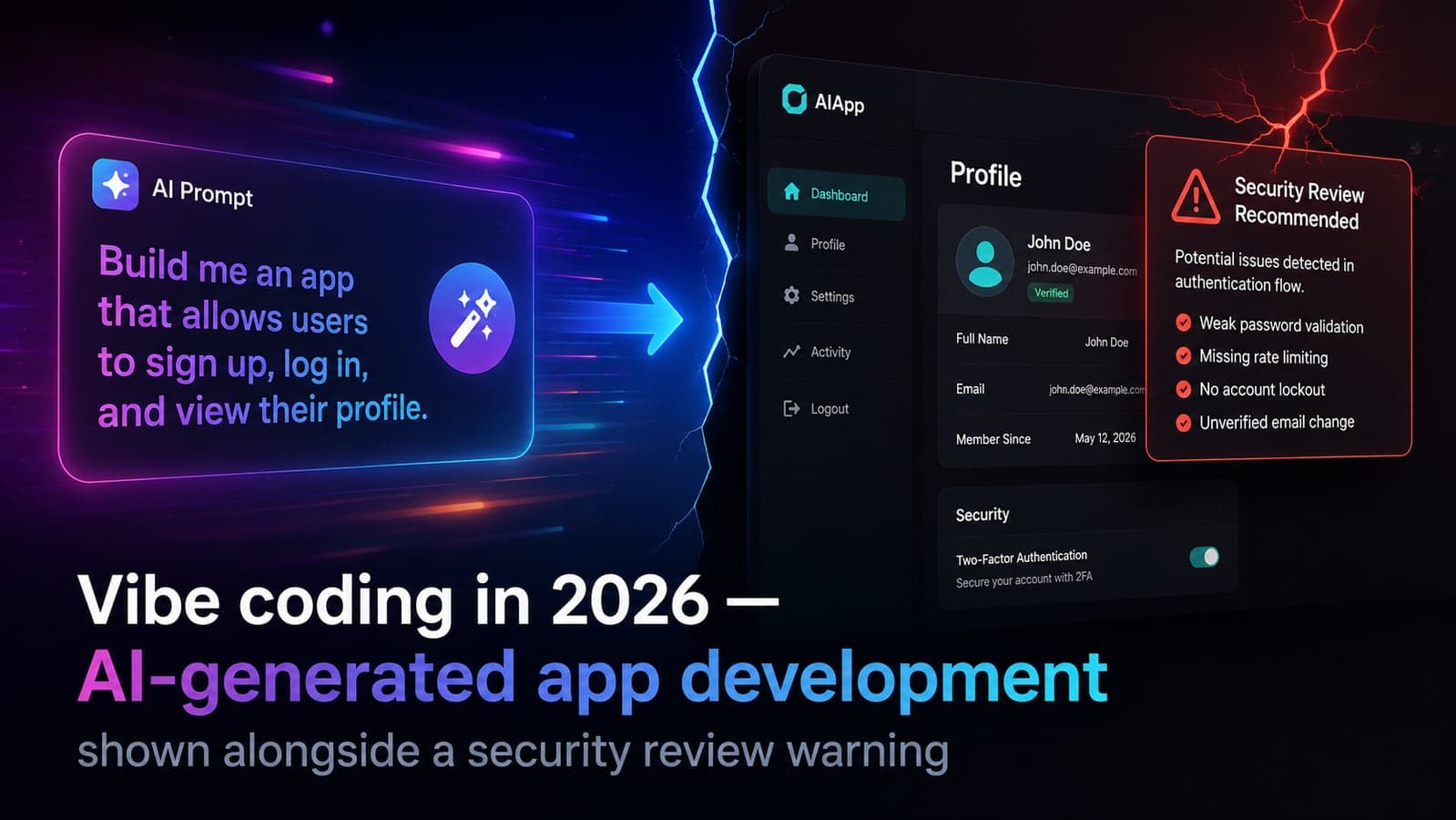
The security data is worse than most founders realize. A Stanford randomized controlled trial found that developers using AI tools wrote less secure code — while feeling more confident about its security. Security firm Tenzai tested five popular vibe coding tools by building 15 identical apps and found 69 vulnerabilities, six of them critical. Independent analysis of AI-authored open-source pull requests found 1.7x more major issues than human-written code, with 45% of samples containing OWASP Top-10 vulnerabilities.
"It runs" is not the same as "it works." 63% of developers report spending more time debugging AI-generated code than it would have taken to write it themselves, at least once. Code churn is up 41% industry-wide, and genuine refactoring — the discipline of actually improving code rather than patching around it — has collapsed from 25% of changed lines in 2021 to under 10% today.
Maintainer trust is breaking down in public. Several high-profile open-source projects shut down external contributions entirely in early 2026 because maintainers could no longer distinguish real fixes from AI-generated noise — one popular curl-adjacent bug bounty program was suspended for exactly this reason.
What We've Learned Building With AI Ourselves
Three things from our own production work that the statistics don't fully capture:
Vibe coding is honest about the easy 80% and dishonest about the hard 20%. Generating a working checkout flow, a CRUD admin panel, or a dashboard shell takes minutes. Making that same code handle the edge case where a customer's payment partially fails, or where two admins edit the same record simultaneously — that's where AI output quietly degrades, and it's exactly the part a demo never tests.
The apps that look most "finished" are often the most fragile. AI tools are extremely good at producing something that looks production-ready in a screenshot. Whether it's actually production-ready — proper error handling, data validation, auth edge cases — takes a trained eye to check, and that eye is the part AI can't yet replace.
The real skill in 2026 isn't prompting — it's knowing what to check. We treat AI-generated code exactly the way the best engineering teams do: like a capable but unsupervised junior developer's pull request. Useful, often impressively fast, and never merged without review from someone who knows what "correct" looks like for that specific system.
The 3-Question Test: Should You Vibe Code This Yourself?
Before deciding whether to prompt it yourself or bring in a developer, ask:
- Is this customer-facing and does it touch money, personal data, or authentication? If yes, the security data above should worry you. This is the tier where an unreviewed vibe-coded feature turns into a breach disclosure, not a launch.
- Will this need to survive contact with real, messy usage? A prototype for a pitch deck has a different bar than a tool your team will run the business on for the next three years. Vibe coding excels at the first; it needs governance for the second.
- Do you have someone who can review the output, or are you trusting it blind? The data is consistent on this single point: reviewed AI-assisted code is a legitimate productivity gain. Unreviewed AI-generated code in production is where almost every horror story in this article comes from.
If you answered "customer-facing," "needs to survive real usage," and "no one can review it" — that's not a vibe-coding project anymore. That's a development project that happens to use AI tools, the same way our team's projects do.
The Bottom Line
Vibe coding isn't a fad and it isn't going away — Gartner expects 60% of new code industry-wide to be AI-generated by the end of 2026, and that number is only going up. The honest 2026 take isn't "vibe coding good" or "vibe coding bad." It's that the industry automated code generation in about eighteen months and has not yet caught up on governance, and the gap between those two curves is exactly where the risk lives.
If you're a founder who's vibe-coded a working prototype and it's time to make it something customers can actually trust — or you're not sure which side of that line your project is on — tell us what you've built. We'll give you an honest read on what's solid, what needs a real review pass, and what it would take to ship it safely. Including when the honest answer is "keep vibe coding it yourself, it's fine for now."
Frequently Asked Questions
What is vibe coding?
Vibe coding is a term coined by AI researcher Andrej Karpathy in early 2025 for building software primarily or entirely through natural-language prompts to an AI tool, rather than writing code by hand. It ranges from professional developers using AI assistance within a reviewed workflow to non-developers building complete applications through prompting alone.
Is vibe-coded software safe to use in production?
It depends entirely on review. Studies show AI-generated code contains more security issues on average than human-written code — one security audit found 69 vulnerabilities, including 6 critical ones, across 15 apps built with popular AI coding tools. Code that is reviewed by an experienced developer before deployment carries much lower risk than code shipped directly from an AI tool with no review.
Can non-developers really build working apps by vibe coding?
Yes, for a meaningful category of software. Non-developers now make up the majority of active users on major vibe coding platforms, and internal tools built this way have measurably reduced spending on off-the-shelf SaaS products. The risk rises sharply for anything customer-facing or handling sensitive data, where the same platforms show high rates of security and reliability issues without expert review.
Will vibe coding replace developers?
The data suggests role change rather than replacement. Senior developers report the largest productivity gains from AI coding tools, not the smallest, because they can direct and verify AI output effectively. Demand is shifting away from writing routine code by hand and toward system design, security review, and knowing when AI-generated output is trustworthy — skills that remain distinctly human.
How do I know when to hire a developer instead of vibe coding it myself?
Three questions help: does the project touch money, personal data, or login credentials; does it need to reliably survive real-world, messy usage rather than a one-time demo; and does anyone with development experience review the output before it ships? If the honest answers point toward risk, it's worth bringing in a developer — even just for a review pass rather than a full rebuild.

 Tayyab Aslam