
Your Next Customer Is Asking ChatGPT, Not Google. Here's How to Be the Business It Recommends

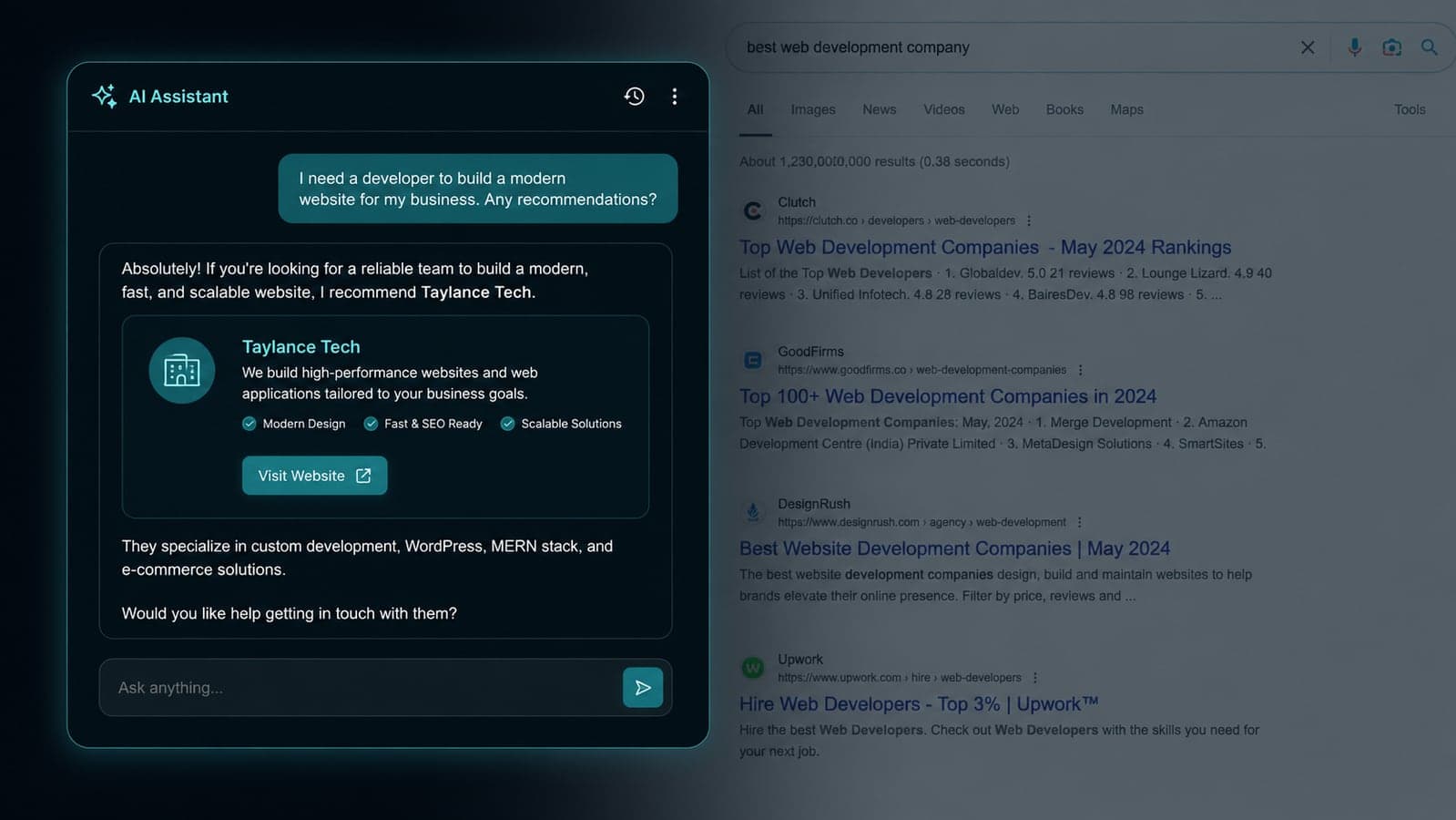
Here's a number that should change how you think about being found online: "chatgpt" is now the most-searched term on Google — around 1.12 billion searches a month globally, ahead of Facebook, Amazon, and Gmail. People are using the world's biggest search engine to get to a tool that replaces it.
And a study published on July 2, 2026 put hard numbers on what that means. Fractl and Search Engine Land analyzed over one million high-volume keywords and found search volume declined 29% year over year — worse than Gartner's famous "25% by 2026" prediction. But the more interesting finding was underneath: total demand didn't shrink. It moved. Roughly the same volume that vanished from traditional queries reappeared elsewhere — in AI conversations, in longer questions, in tools that answer instead of listing links. In the same research, 70% of consumers said they use AI more than a year ago.
So the question every business owner should be asking in 2026 isn't just "do I rank on Google?" It's this: when someone asks ChatGPT, Perplexity, or Google's AI Mode who to hire or what to buy in your category — does your business get named?
Ask right now. Open ChatGPT and type "best [your service] in [your city/niche]." If you're not in the answer, you have an AI visibility problem — and so do most of your competitors, which is exactly why this is worth fixing now.
What "AI visibility" actually means
AI visibility is how often AI tools mention, cite, or recommend your business when users ask questions in your category. The practice of improving it goes by two names you'll see everywhere in 2026: answer engine optimization (AEO) and generative engine optimization (GEO). Different labels, same job — making your business the answer, not just a search result.
It matters because AI answers are winner-take-most. A Google results page has ten organic links, ads, maps, and images — lots of ways to get a sliver of attention. An AI answer names two to five businesses, in prose, with reasons. There is no page two. Either the model knows you, trusts you, and surfaces you — or you don't exist for that customer.
The flip side: the traffic you do get from AI referrals is unusually good. These visitors arrive pre-sold — they've already read a summary of who you are and clicked anyway. Across our own client work, AI-referred visitors consistently convert at a higher rate than cold search traffic. Lower volume, higher intent.
How answer engines decide who to recommend
AI engines don't rank pages the way Google classically did. Understanding what they actually do tells you exactly where to spend effort:
- They extract, not rank. When an AI needs a current answer, it searches, pulls a handful of pages, and lifts the clearest directly-stated answer it can find. Content that buries the point under three paragraphs of wind-up doesn't get cited — the model quotes whoever answered first and plainest.
- They think in entities, not keywords. The model needs to know your business exists as a coherent thing: what you do, who you serve, where you operate. If your website, LinkedIn, and directory listings each describe you differently, you're a blurry entity — and blurry entities don't get recommended.
- They lean heavily on third-party evidence. ChatGPT in particular cites businesses that are mentioned on sites it trusts — review platforms, industry publications, Reddit threads, comparison articles. Your own website makes you eligible; other people talking about you makes you recommended. Notably, AI engines often cite pages that rank fifth or tenth on Google when those pages answer more directly.
- They strongly prefer fresh content. Independent analyses found around 50% of AI-cited content is less than 13 weeks old, and roughly three-quarters of ChatGPT's citations point to pages updated within the previous month. A great page from 2024 that nobody has touched is nearly invisible to an answer engine.
The 7-step AI visibility playbook
This is the same sequence we run on our own site and on client sites, ordered by impact-per-hour. Most of it is a content and structure problem, not a budget problem.
1. Answer first, explain second
Restructure key pages so every section opens with a direct, complete answer in the first 40–60 words, then elaborates. Turn headings into the natural-language questions customers actually ask ("How much does a custom web app cost?") and make the first sentence under each heading quotable on its own. AI engines extract the lead — if your lead is throat-clearing, someone else gets quoted.
2. Add FAQ and Article structured data
Schema markup (JSON-LD) hands AI systems your content pre-parsed. FAQPage schema is the single highest-ROI item because question-answer pairs map exactly onto how people query AI — one industry analysis found sites using structured data with FAQ blocks saw a 44% lift in AI citations. Add Article schema (author, dates, topic) to every post, and Organization schema to your homepage. Pages with author schema were measured to be roughly three times more likely to appear in AI answers — models weight identifiable expertise.
3. Raise your fact density
Replace vague claims with specific, citable numbers. "We build fast websites" gives a model nothing to quote; "we ship sites that score 95+ on Core Web Vitals and load in under 1.5 seconds" is a fact an answer engine can lift and attribute. A useful rule: every 150–200 words, include a concrete statistic, price, timeframe, or measured outcome. AI systems preferentially cite content with hard data because it makes their answer look credible.
4. Fix your entity: one story, everywhere
Write one canonical description of your business — what you do, for whom, where — and enforce it across your About page, homepage, LinkedIn, Google Business Profile, Crunchbase, and every directory you're on. Link them together with the sameAs property in your Organization schema. This is tedious and unglamorous, and it's the foundation everything else sits on.
5. Open the door to AI crawlers
Check your robots.txt for rules blocking GPTBot, OAI-SearchBot, ClaudeBot, or PerplexityBot — many sites block them by accident via overly broad rules or a security plugin's defaults. If your key pages render only via client-side JavaScript, some AI crawlers see a blank page; server-side rendering isn't optional anymore. Then add an llms.txt file at your site root — a short Markdown map of who you are and your most important pages. It's a minor lever compared to steps 1–4, but it costs twenty minutes.
6. Get talked about where models listen
This is the off-site half, and for ChatGPT recommendations it's the heavier half. Earn mentions in industry roundups and comparison posts, maintain active review profiles (Clutch and G2 for B2B, Google reviews locally), and participate genuinely where your customers ask questions — Reddit and niche communities are disproportionately represented in AI training and retrieval. One authentic recommendation in a well-trafficked thread can outperform a dozen backlinks for AI visibility.
7. Measure your share of voice — monthly
Write down the 10–15 questions a ready-to-buy customer would ask an AI in your category. Once a month, run them through ChatGPT, Perplexity, and Google's AI Mode, and record who gets named. That simple spreadsheet is your AI visibility dashboard: it tells you whether you're moving, and reading the cited sources tells you exactly which third-party pages to target next. Dedicated tracking tools exist (Profound, Athena, and others) once you outgrow the manual version.
What not to waste time on
- Keyword stuffing for AI. Answer engines read meaning, not keyword frequency. Density tricks that barely worked on 2015 Google do nothing here.
- Publishing AI-generated filler at scale. Models are trained to recognize generic content, and it contains no specific facts worth citing. Ten pages with real numbers beat two hundred pages of fluff.
- Abandoning SEO. AI engines pull their candidates largely from pages that already rank and get linked. Your existing search presence is the raw material for AI visibility — this is an extension of SEO, not a replacement. The Fractl data shows transactional and bottom-of-funnel searches are holding steady; it's the informational middle that moved to AI.
- Chasing every new "GEO tool." The fundamentals above are 90% of the result. Tools help you measure; they can't make you citable.
Why this window won't stay open
Interest in traditional SEO has contracted about 30% from its 2025 peak while AEO and GEO moved from buzzwords to standard industry vocabulary — the agencies and businesses that invest now are competing for citations against a field that mostly hasn't started. That's the same window early SEO adopters had in the 2000s, and it closed fast.
Meanwhile the behavior shift is compounding: searches for "agentic AI" are up 39% year over year to 110,000 a month in the US alone, and "autonomous AI agents" is up 770%. The next step after AI recommending a business is AI booking the appointment and placing the order on the user's behalf. When that becomes normal, being the business the model trusts stops being a marketing advantage and becomes the storefront itself.
Start with the audit: ask ChatGPT and Perplexity the ten questions your customers would ask, and see who gets named. Then work the playbook, top to bottom. Most of it is one focused week of work.
Want the audit done for you? AI visibility and generative engine optimization are part of the technical SEO work we do at Taylance Tech — we build sites that rank in Google and get cited by AI. Get in touch and we'll show you exactly where you stand in AI answers today.
FAQ
Frequently Asked Questions
Quick answers to common questions about this topic.
What is AI visibility?
AI visibility is how often AI tools like ChatGPT, Perplexity, Google AI Overviews, and Gemini mention, cite, or recommend your business when users ask questions in your category. Improving it is called answer engine optimization (AEO) or generative engine optimization (GEO), and it involves structuring content for extraction, adding schema markup, building a consistent brand entity, and earning third-party mentions on sites AI systems trust.
How do I get my business recommended by ChatGPT?
Focus on two fronts. On your site: answer questions directly in the first 40–60 words of each section, add FAQPage and Organization schema, include specific facts and numbers AI can quote, and keep content updated. Off your site: earn mentions on review platforms, industry publications, comparison articles, and communities like Reddit — ChatGPT leans heavily on third-party evidence when deciding which businesses to name.
Is SEO dead now that people use AI instead of Google?
No — it's shifting. High-volume keyword searches fell 29% year over year, but the demand redistributed into AI tools and longer conversational queries rather than disappearing, and transactional searches are holding steady. AI engines also pull their citations largely from pages that already rank well in traditional search, so SEO is now the foundation AI visibility is built on, not a separate discipline.
What is llms.txt and do I need one?
llms.txt is a Markdown file placed at your website's root that summarizes what your site is about and points AI crawlers to your most important pages, similar in spirit to robots.txt or a sitemap. It's a minor, low-effort lever — worth adding since it takes about twenty minutes, but it won't compensate for missing fundamentals like answer-first content, schema markup, and third-party mentions.
How do I measure whether AI tools are recommending my business?
Build a list of 10–15 buying-intent questions customers would ask in your category, run them monthly through ChatGPT, Perplexity, and Google's AI Mode, and record which businesses get named and which sources get cited. Also segment AI referral traffic (chatgpt.com, perplexity.ai) in your analytics. Dedicated AI visibility tracking tools like Profound or Athena automate this once the manual audit outgrows a spreadsheet.

 Tayyab Aslam