Patients and families managing chronic medication need more than a phone alarm. Doses get missed, histories are scattered across paper and messages, and caretakers often lack a shared view of what was taken and when. A missed evening dose might only surface days later when someone notices an empty blister pack. Any health product also has to feel trustworthy — clear language, careful UX around suggestions, and data handling that respects sensitivity even in an MVP. We could not ship a product that reads like a chatbot playing doctor or that shares health data by default across family members.
Our solution
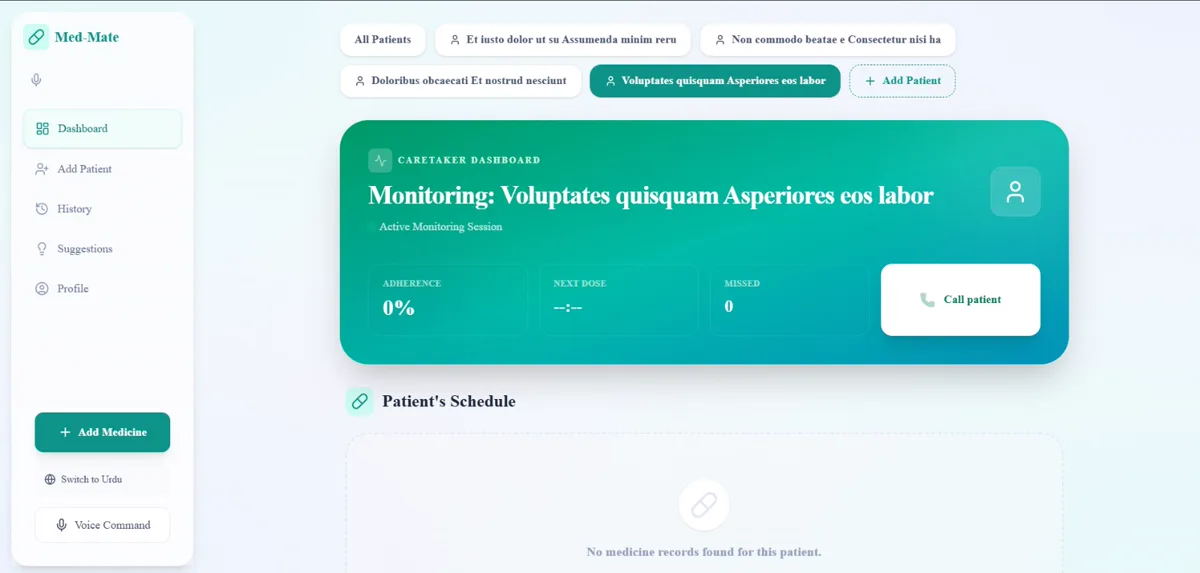
Med-Mate combines scheduled reminders, a patient history timeline, and a caretaker dashboard so the people supporting a patient see the same picture. AI suggestions are framed as informational prompts, not diagnoses, with copy and flows reviewed for clarity and restraint. Patients mark doses taken or skipped; the timeline becomes the source of truth for adherence conversations with clinicians. Caretakers receive summaries — not raw notes — unless the patient explicitly expands sharing.
How we approached it
Reminder scheduling supports recurring patterns and snooze without losing audit history. Skipped doses remain visible so patterns emerge over weeks, not just today's alarm.
Caretaker roles see adherence summaries; patients control what is shared through per-profile permissions rather than a single household toggle.
Supabase auth and row policies separate household accounts where multiple profiles exist — a parent managing two dependents does not commingle their medication histories.
AI copy passes a restraint review: no diagnostic language, no treatment recommendations, and clear escalation paths to licensed care when symptoms sound urgent.
Implementation notes
Med-Mate balances helpful prompts with careful copy — suggestions are framed as informational, not diagnostic. That restraint matters in any health-adjacent product we build for clients where regulatory tone and user trust are non-negotiable.
Caretaker visibility was designed as opt-in sharing from the patient profile, not a surveillance dashboard. The goal is coordination between family members — who picked up the prescription, whether the morning dose happened — not replacing clinical advice.
The reminder engine runs client-side schedules with server-backed history so notifications still fire if the app was closed, while adherence data syncs when connectivity returns.
Supabase row-level policies separate household accounts where multiple profiles exist, which is the same multi-tenant pattern we use in client SaaS builds: one login, many scoped records, zero cross-leakage.
Results
Medicine reminder flows with history tracking
Caretaker dashboard for shared visibility
AI-assisted health suggestions with careful UX framing
An automated compliance platform scanning URLs for WCAG 2.1/2.2 AA accessibility failures, GDPR cookie consent banners, and EU AI Act disclosures with instant reporting at auditbloc.taylancetech.com.